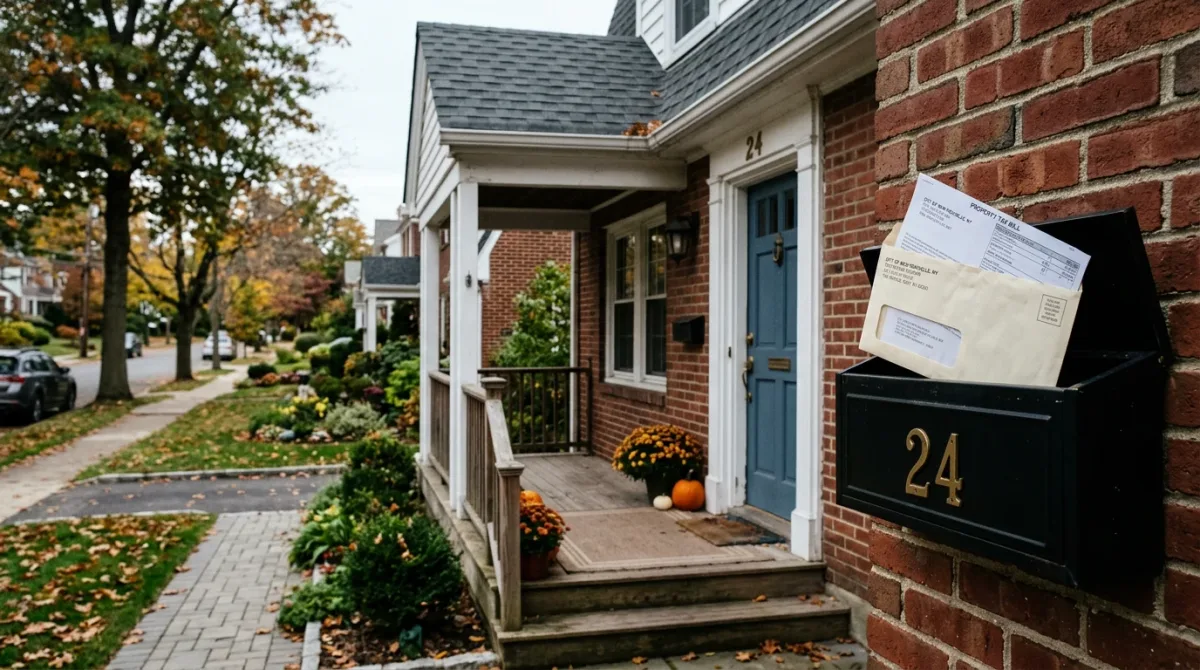
Clarkstown homeowners who meet income and residency rules can lower their school tax bill through STAR, the state's School Tax Relief program, which exempts the first $30,000 of a home's assessed value — more for seniors — administered locally by the Town Assessor's office, according to Clarkstown and state tax department records.
STAR is a New York State benefit, not a town program, but every one of Rockland's towns and villages processes it through its own assessor. In Rockland News, that distinction comes up often: residents get a state check or a line on a local school tax bill, and the office fielding their questions about it sits in town hall, not Albany.
What is STAR, and who qualifies?
STAR only applies to school district taxes, not county, town, or village levies, and it comes in two tiers: Basic STAR, open to any owner-occupied primary residence regardless of age, and Enhanced STAR, a larger benefit for households with at least one owner age 65 or older, according to the New York State Department of Taxation and Finance's eligibility rules.
To qualify for either tier, the property must be the applicant's primary residence and the owners must meet an income limit. For Basic STAR, combined income of the resident owners and their spouses must be $500,000 or less to get the STAR credit, or $250,000 or less for homeowners still receiving the older STAR exemption. Non-resident co-owners' income isn't counted.
Do I get an exemption or a check?
Homeowners who registered for STAR before 2015 and have stayed in the same home since can keep receiving it as the STAR exemption — a line-item reduction directly on the school tax bill. Everyone who registers today gets the STAR credit instead: a check or direct deposit from the state, sent before the school tax bill is due, that the homeowner uses to pay it.
The two versions aren't interchangeable at will — a homeowner keeping the older exemption can switch to the credit through the state's Homeowner Benefit Portal, but the reverse isn't offered. The Tax Department notes that switching from the exemption to the credit can matter for anyone paying school taxes through a mortgage escrow account, since the lender should be told about the change.
How much does it save homeowners?
Basic STAR is calculated against the first $30,000 of a home's full value. Enhanced STAR, for the 2026–2027 school year, is calculated against the first $88,500 of full value — nearly three times as much sheltered from the school tax rate. Because the benefit is based on assessed value and each school district's tax rate, the dollar savings differ district to district; the program itself doesn't set a flat statewide check amount.
What about seniors — does Enhanced STAR have its own income limit?
Yes, and it changes yearly. Only one resident owner needs to be 65 or older by December 31 of the benefit year, but the household's combined income must fall under a specific ceiling: $110,750 or less for 2026 benefits, rising to $113,550 or less for 2027 benefits, per the state's published eligibility table. A surviving spouse can keep an existing Enhanced STAR benefit if they're at least 62 when their age-eligible spouse dies, and otherwise steps up to Enhanced STAR automatically once they turn 65.
How does Clarkstown handle STAR locally?
In Clarkstown, the Town Assessor's Office — currently led by Assessor John Noto, based at Town Hall on Maple Avenue — is the office responsible for administering exemptions on the town's tax rolls, including the STAR exemption for households that registered before 2015, along with veterans, disability, and senior exemptions. The office also runs the annual grievance period during which property owners can formally contest their assessment, separate from the STAR registration itself.
That local role matters because STAR eligibility and STAR exemption status are tied to what's on file with the town, even though the credit itself is issued by the state. A resident who moves, marries, or otherwise changes ownership of a STAR-registered home needs to update that registration — and, for anyone still receiving the older exemption rather than the credit, the assessor's office is where that change of status against the tax roll gets recorded.
How do I register or update my STAR benefit?
New homeowners, or anyone not currently receiving a STAR benefit on their primary residence, register directly with the state rather than through the town. The process requires a state Individual Online Services account, the names and Social Security numbers of all property owners and spouses, the school district name, and 2024 income tax return information (or, for those not required to file, a breakdown of wages, Social Security, and other income). Once registered, most homeowners don't need to reapply in later years — the state reviews eligibility annually and reissues the credit automatically, unless there's an ownership change to report.
The bottom line for Rockland homeowners
STAR isn't a one-time application — it's a benefit that, once registered, keeps running in the background of a homeowner's school tax bill every year, checked and reissued by the state. For most Rockland households the entry point is simple: primary residence, income under the relevant limit, and a registration filed once. For the smaller group still holding the pre-2015 exemption, the local assessor's office remains part of the picture, since that benefit lives on the town's tax roll rather than in a state-issued check.
For more context, read Why your Union County tax bill jumped this year.
For more context, read Monroe adds 8,000 residents, outpaces Union County growth.
For more context, read The Five-Day Mandate and the Rebirth of Main Street.