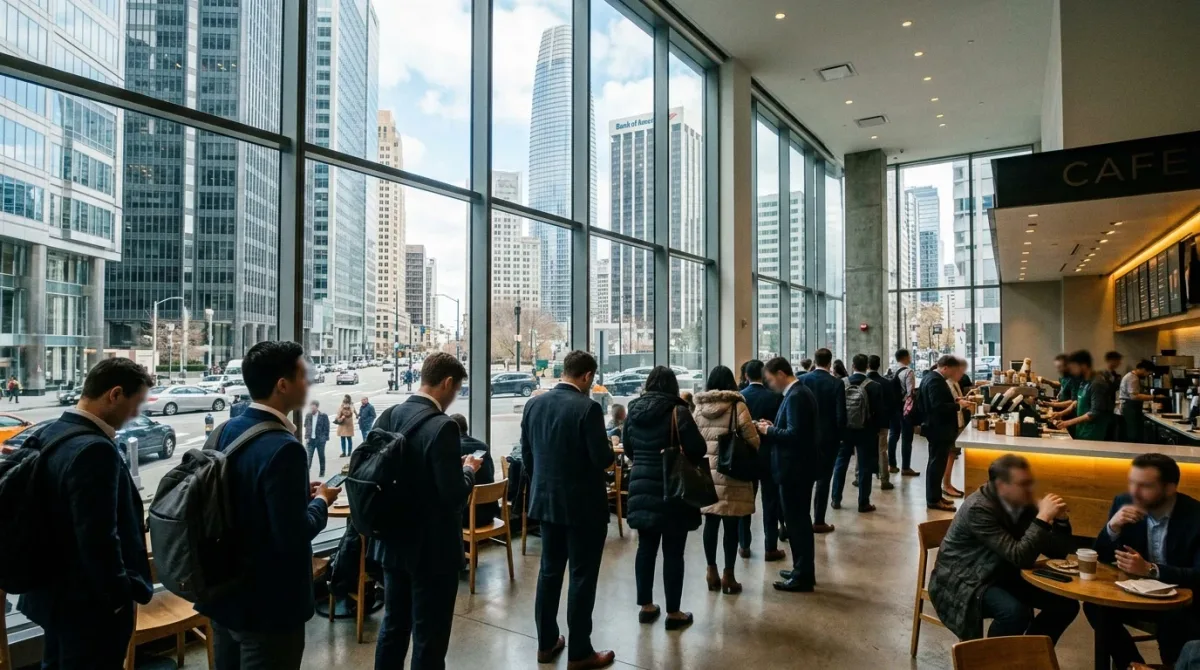
When Amazon ordered roughly 350,000 corporate employees back to five-day office weeks starting in January 2025, weekday foot traffic in Seattle's Denny Regrade and South Lake Union neighborhoods rose 22 percent over the prior month and 36 percent year over year, according to a Downtown Seattle Association survey cited by the Washington Retail Association. The jump, concentrated on Mondays and Fridays that had emptied out during the hybrid-work years, offers the clearest evidence yet that a single employer's office policy can move a neighborhood's economic weather more decisively than any downtown-revitalization program a city council has passed since 2020.
For the better part of five years, the coffee shops, dry cleaners, sandwich counters and parking garages that ring corporate campuses have functioned as a kind of shadow workforce, their revenue rising and falling on decisions made in human-resources departments they never see. As a wave of large employers — Amazon and JPMorgan Chase chief among them — has ended hybrid schedules in favor of five-day attendance, that dependency has become measurable, and the data now offer the clearest picture yet of what a corporate mandate is worth to the small businesses standing in its shadow.
A Mandate Measured in Coffee Cups Sold
The change was visible before it showed up in any spreadsheet. "Coffee shops are full, lunch spots are buzzing and there's more activity in the area," Jon Scholes, president and chief executive of the Downtown Seattle Association, said of the neighborhoods surrounding Amazon's headquarters campus. The rollout itself was not smooth — employees who had grown used to remote schedules found themselves short on desks and parking in the mandate's first weeks, according to reporting on the policy's early months — but the retail effect downtown was immediate. Weekday foot traffic across the district climbed 9 percent, reaching 57 percent of January 2019 levels, with an average of 46,000 people moving through downtown on a given weekday, or about 74 percent of pre-pandemic volume. For merchants who had spent years watching Tuesday-through-Thursday become the only reliable business days, the return of Monday and Friday customers changed the math of staffing a full week.
The Numbers Behind the Comeback
By the summer of 2025, downtown Seattle was averaging more than 90,000 workers on a typical weekday, a 14 percent increase from the year before, according to foot-traffic tracking published by Downtown Recovery. The pattern held nationally but unevenly: downtown retail corridors across the country were still running 16 to 17 percent below 2019 levels on Monday through Thursday as of early 2026, with morning hours between 7 and 11 a.m. down nearly 24 percent, even as March 2026 registered the busiest month for office visits since the pandemic began, at 26.5 percent below 2019 baselines. Denver's downtown reached a 74 percent weekday return-to-office rate that same month, with pedestrian activity climbing to 84 percent of March 2019 levels — evidence that where employers mandate attendance and workers comply, the sidewalk economy tends to follow within a matter of months, not years.
Uneven Return, City by City
Not every city has seen the same rebound, and the gap says as much about the limits of corporate policy as about its power. San Francisco has continued to register weekday foot traffic well under half of pre-pandemic levels despite strong office-leasing demand from technology firms, according to the same foot-traffic data, a divergence from Seattle's and Denver's recoveries even where the office towers themselves are full. For the shop owners who lease space near a downtown tower, the difference between a mandate that sticks and one that erodes under attrition or relocation is the difference between a lease renewal and a closing sale — a distinction that no single employer's memo can guarantee, since it depends on whether the workforce it summons back actually stays in the city to be summoned.
The Real Estate Behind the Rebound
The mandates have reshaped commercial real estate as much as sidewalks. Amazon, whose chaotic initial rollout left some employees without assigned desks, signed a lease in August 2025 for an additional 259,000 square feet with WeWork at 1440 Broadway in Manhattan, on top of more than 300,000 square feet it already occupied in the building; WeWork separately operates 702,000 square feet across two other Amazon office locations in Manhattan. JPMorgan Chase, Lyft and Pfizer have taken similar overflow space from coworking operators as their own five-day policies strained existing footprints, a sign that the mandates arrived faster than the real estate built to house them. The pattern reflects a broader swing in flexible-office demand: coworking space nationally grew 51.7 percent, from 115.6 million square feet across roughly 5,800 locations three years ago to 158.3 million square feet across about 8,800 locations today, with the global flexible-office market projected to reach $96.8 billion by 2030, up from $34.8 billion in 2023. Every one of those additional square feet sits near a lobby, a lunch counter and a coffee line that depends on someone walking through the door.
What Companies Say, What the Sidewalks Show
Employers that impose five-day mandates almost never frame them as economic-development policy. Amazon and JPMorgan have both described their requirements as decisions about collaboration, mentorship and company culture, not downtown revitalization, and neither company has publicly credited its policy with reviving the small businesses around its offices. But the documented outcome, at least in Seattle and Denver, is a version of civic repair that no mandate memo promised: fuller coffee counters, steadier lunch-hour receipts, a sidewalk economy that had spent years absorbing the cost of decisions made in offices far from Main Street. The desk shortages and parking crunches that greeted Amazon's own returning employees are a reminder that the mandate was not designed with the surrounding neighborhood in mind — the benefit to nearby merchants was a byproduct, not the intent.
Whether that recovery holds depends on choices that sit well outside any single employer's control: transit reliability, housing costs near office cores, and whether workers who are ordered back choose to stay in a city rather than trade a five-day commute for an employer willing to let them work from home. San Francisco's stalled recovery, even amid heavy office-leasing demand, suggests that a mandate is necessary but not sufficient. For now, the clearest evidence available comes from the neighborhoods where it worked: a downtown coffee line in South Lake Union, a lunch spot in the Denny Regrade, filling back up on a Monday morning because a corporate calendar changed. It is a fragile kind of recovery, dependent on a policy that a single earnings call or leadership change could reverse, and it leaves the small businesses that benefit from it with no seat at the table where the decision gets made.
For a related society perspective, read How the WARN Act's 60-Day Clock Actually Works.
For more context, read Why Did Calvin Klein Choose Broadway Over Madison Avenue?.
For more context, read Why your Union County tax bill jumped this year.
For more context, read Monroe adds 8,000 residents, outpaces Union County growth.