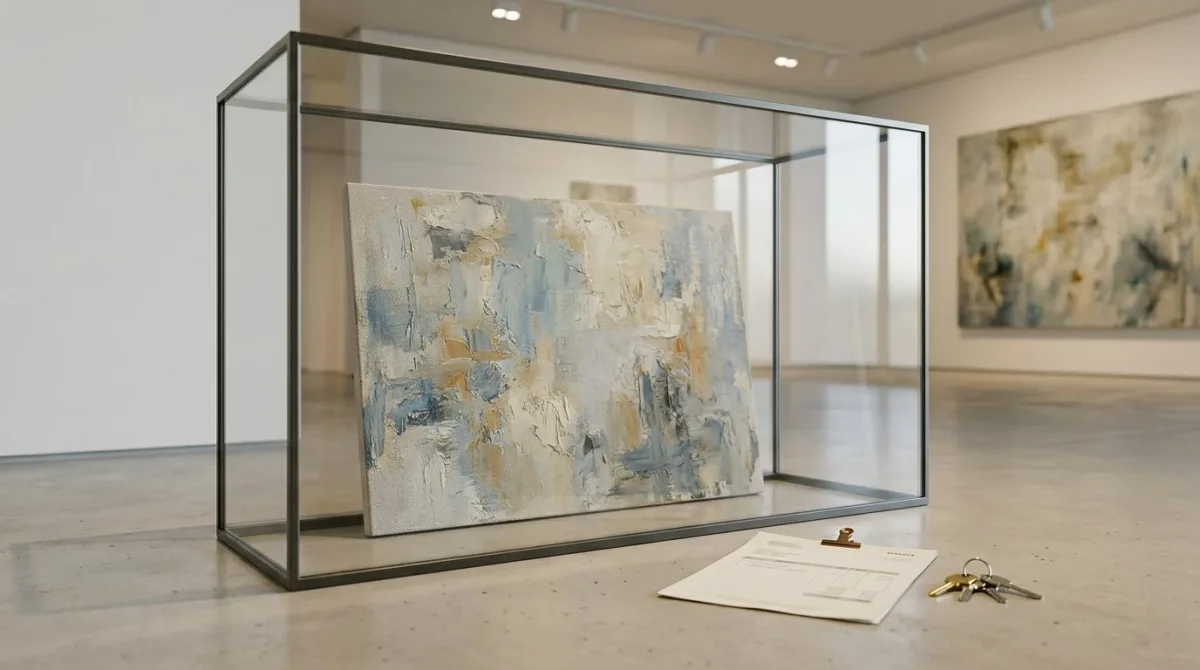
Hand a painting to a New York gallery for exhibition or sale and, under the state's Arts and Cultural Affairs Law § 12.01, that work becomes trust property in the dealer's hands the moment it is accepted. No signed contract is required for this to happen. Money from the sale becomes trust funds, and a gallery cannot ask an artist to sign away the first $2,500 of gross proceeds in any twelve-month period.
That is the single most useful paragraph of law a working artist in this city can carry around, and plenty of people showing in storefront spaces in Bushwick, Ridgewood and the Lower East Side have never read it. It is not a clause you negotiate for. It is not something a dealer grants you as a favor. It is the default condition of the relationship, written into state law, and it attaches on delivery.
The reason it matters is unglamorous and entirely about money. Galleries are small businesses with landlords, art fair booths, shipping bills and payroll, and when a business like that runs short, the cash in its account is the cash it reaches for. The statute's whole design is to make your work and your share of the sale legally different from the gallery's own money, so that when things go wrong the artist is not standing in line with everyone else the gallery owes.
What follows is a plain reading of what the statute says. It is a guide, not legal advice, and an artist with an actual dispute needs an actual lawyer.
What does "trust property" actually mean here?
It means the gallery holds your work as your agent, not as its own inventory. New York's Arts and Cultural Affairs Law § 12.01 states that delivery to and acceptance by an art merchant "establishes a consignor/consignee relationship," that the work "is trust property in the hands of the consignee," and that sale proceeds are "trust funds."
The consequence is the important part. Because the work and the money are trust property, the statute says they do not become the property of the gallery and are not "subject or subordinate to any claims, liens or security interest of any kind." A dealer's bank, a dealer's landlord, a dealer's other creditors: none of them are supposed to be able to reach the canvas hanging in the back room, because it was never the dealer's to pledge.
Nothing about that depends on paperwork. The relationship is established by the physical act of handing over the work and the gallery accepting it for exhibition or sale. A handshake show in a Ridgewood apartment gallery is covered by the same sentence as a Chelsea contract drafted by a firm.
Does the protection survive once the work is sold?
Yes. Under § 12.01 the trust attaches to the proceeds as well as the object, so once a collector pays, the artist's share is trust money in the gallery's hands rather than general revenue. That is the provision that separates a slow-paying gallery from a gallery that has quietly spent an artist's money on its own rent.
This is also the practical difference between the statute and an ordinary unpaid invoice. An artist chasing a plain debt is a creditor arguing about a bill. An artist chasing trust funds is arguing that the gallery held money in a fiduciary capacity and failed to treat it that way, which under subdivision 2 of the section constitutes a violation.
What if the gallery buys the piece for itself?
The statute anticipates that move. If a work first received on consignment is later purchased by the gallery for its own account, § 12.01 keeps the work as trust property "until the price is paid in full to the consignor." A purchase order does not convert your painting into the dealer's asset on the day it is signed.
And if the gallery resells that work to a third party before it has paid the artist in full, the statute treats the resale proceeds as trust funds too, up to the amount still owed. The chain of protection follows the money rather than stopping at the first transaction, which is exactly where informal deals tend to break down.
Can a gallery ask an artist to waive any of this?
Only narrowly. The statute allows waiver of one clause — the one making proceeds trust funds — and only when the waiver is "clear, conspicuous, in writing," specifically explains to the artist what is being given up, and is signed by the artist. Every other provision of the section is not waivable at all.
Two hard limits sit on top of that. No waiver is valid as to the first $2,500 of gross proceeds in any twelve-month period, and no waiver applies to a work the gallery received on consignment and then bought for itself. So even an artist who signs a broad waiver keeps a floor of protected money and keeps the full protection on any piece the gallery later purchases.
The reading to take from this is simple: a contract term that says the gallery owns your work outright on delivery, or that its bank can treat your inventory as collateral, is not a term New York law lets a dealer buy from you.
What can an artist do when a gallery breaks the rule?
The section gives an injured party the right to bring an action "to enjoin such unlawful act, to recover his or her actual damages, or both," and lets the court award "reasonable attorneys' fees, costs and expenses." That fee provision is the one that changes the arithmetic for artists whose claims are worth less than a retainer.
Art lawyer Judith Wallace, writing in Artnet News in 2013 about the 2012 amendments to the law, described the fee-shifting right as one that may "promote awareness and enforcement" of the statute, alongside criminal penalties for non-compliance and an extension of the protections to artists' estates. She also made the point that no artist wants to hear: fee-shifting helps little if a gallery has already dissipated the funds and has nothing left to satisfy a judgment.
Which is why her practical advice in that analysis of the amended law is worth more than the litigation section. Wallace recommended that artists specify New York law governs the relationship, require regular accountings at least annually, require payment within a set number of days after a sale, and ask to be told whenever work is re-consigned to another dealer. Written terms do not replace the statute; they make it enforceable before the money is gone.
Where does the law stop?
It stops well short of a guarantee. Section 12.01 defines the legal status of the work and the money and gives artists a cause of action, but it does not chase down a dealer who has moved, it does not conjure funds that no longer exist, and it does not resolve on its own what a federal bankruptcy court will do with a gallery's estate.
It also is not the only relevant section. A separate provision of the same law, § 12.03, shields fine art from attachment, execution, replevin and other seizure while the work is in transit to or from an exhibition or on display at a nonprofit museum, college or cultural organization in the state — a different protection, aimed at loans to institutions rather than at commercial consignment.
For most artists the useful takeaway is behavioral rather than legal. Keep a dated record of every work delivered, with title, year, materials and agreed price. Ask for an accounting in writing on a schedule. Ask where the work is when it is not on the wall. The statute already treats your work and your money as yours; the paperwork is what makes that easy to prove.
For a related art perspective, read How New York City's Percent for Art Law Pays Working Artists.
For more context, read Why your Union County tax bill jumped this year.
For more context, read The Five-Day Mandate and the Rebirth of Main Street.
For more context, read The 90-Day Clock Behind US Foreign Deal Reviews.