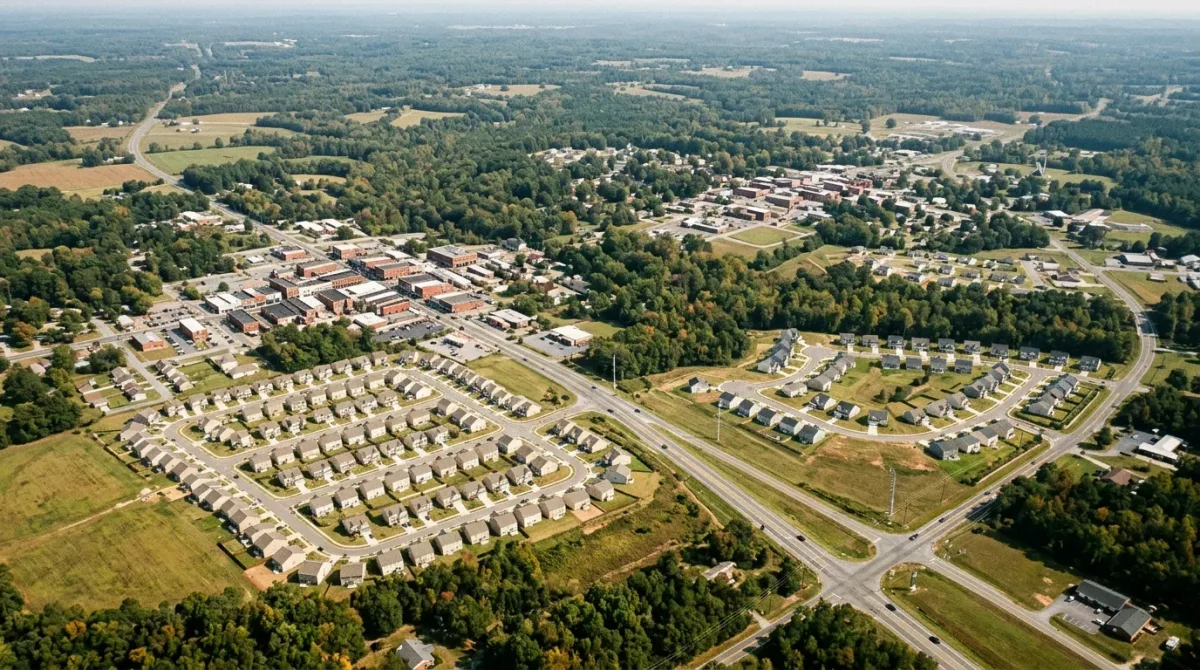
Union County added 29,407 residents between April 2020 and July 2025, a 12.4% increase, according to U.S. Census Bureau population estimates. Monroe grew far faster than the countywide pace, adding 8,082 people for a 23.1% increase — nearly double the county's overall rate.
The gap shows growth is not landing evenly across Union County's towns. Waxhaw, Indian Trail and Weddington are all adding thousands of residents too, but each is growing at roughly half Monroe's rate, and each looks different once housing and ownership figures are broken down.
All four towns sit on the Charlotte metro's southeastern edge, within commuting range of the city but outside it. That shared geography has not produced a shared growth pattern: the Census Bureau's five-year estimates put Monroe, Indian Trail, Waxhaw and Weddington on four distinct trajectories, distinguished as much by housing type and cost as by raw speed of growth.
How the towns compare
Census Bureau estimates put Union County's population at 267,674 as of July 2025, up from 238,267 at the 2020 census. Four of the county's incorporated towns show a similar pattern: steady growth, with Monroe well out front.
| Municipality | 2020 population | 2025 estimate | Change |
|---|---|---|---|
| Monroe | 34,562 | 42,644 | +23.1% |
| Indian Trail | 39,997 | 44,303 | +10.3% |
| Waxhaw | 20,534 | 23,140 | +12.6% |
| Weddington | 13,181 | 14,517 | +10.2% |
| Union County (overall) | 238,267 | 267,674 | +12.4% |
Indian Trail remains the county's largest town by population, but its 10.3% growth rate since 2020 tracks close to the county average. Monroe, the county seat, is the outlier — and the numbers behind that gap point to where new construction is concentrated.
Indian Trail adds more people, just not the fastest rate
Raw numbers tell a slightly different story than percentages. Indian Trail added 4,306 residents between 2020 and 2025, the second-highest total among the four towns, even though its 10.3% growth rate ranks near the bottom of the group. At 44,303 residents, it remains the largest of Union County's incorporated towns, ahead of Monroe's 42,644.
Waxhaw and Weddington added smaller numbers in raw terms — 2,606 and 1,336 residents, respectively — despite Waxhaw's percentage growth rate of 12.6% edging out both Indian Trail and Weddington. Combined, Waxhaw and Weddington added 3,942 residents over five years, fewer than Monroe added on its own.
That distinction matters for how residents read growth headlines. A high percentage rate in a smaller town, like Weddington's 10.2% on a base of 13,181, produces a modest raw number. Monroe's 23.1% rate on a much larger base produced the single biggest population gain of any town in the county.
Monroe is absorbing the county's growth first
Union County issued 2,707 building permits in 2025, according to Census Bureau estimates. The bureau does not break that permit count out by municipality, but Monroe's population gain of 8,082 residents in five years — more than any other town in the county — lines up with a city that has been annexing and permitting new subdivisions on its edges throughout the period.
Monroe's median home value was $309,100 as of the 2020-2024 American Community Survey period, below the countywide median of $417,300. That gap helps explain why Monroe has absorbed a disproportionate share of new residents: it is the more affordable entry point into a county where housing costs have risen sharply.
Monroe's median gross rent was $1,246 over the same period, and the city had 12,620 total households. Those figures describe a rental and starter-home market distinct from the county's smaller towns.
Waxhaw and Weddington are growing a different way
Waxhaw and Weddington are adding residents at close to the same percentage rate as each other — 12.6% and 10.2% — but their housing profiles diverge sharply from Monroe's. Waxhaw's owner-occupied housing rate was 83.0% for 2020-2024, and Weddington, the smallest of the four towns at 14,517 residents, has long drawn buyers seeking larger lots outside Monroe's core.
Monroe's owner-occupied rate, by contrast, was 61.6% over the same period — nearly 20 percentage points lower than Waxhaw's. That split reflects two different growth patterns inside one county: Monroe adding a mix of rental housing and starter homes, while Waxhaw and Weddington add predominantly owner-occupied single-family construction.
What the numbers don't settle
The Census Bureau's county-level owner-occupancy rate was 81.6%, closer to Waxhaw's and Weddington's pattern than to Monroe's, which underscores how much a countywide average can obscure. Reading Monroe's numbers alongside Waxhaw's or Weddington's shows two distinct housing markets operating inside county lines that are otherwise treated as a single growth story.
Union County's total housing stock stood at 95,683 units as of July 2025, and the 2,707 permits issued that year represent new supply layered onto that base. The Census Bureau does not publish a town-by-town breakdown of those permits, so which municipality captured the largest share of 2025's building activity is not something these estimates can confirm on their own.
What the estimates do confirm is a documented pattern across five years: Monroe's population grew at roughly twice the countywide rate, on a housing market with a lower median home value and a lower owner-occupied share than Waxhaw, Weddington or the county as a whole. Indian Trail added the second-largest number of new residents while growing at a rate close to the county average, and Waxhaw and Weddington grew at similar percentage rates while adding far fewer people in raw terms than Monroe did alone.
None of these figures forecast where home values go next, and the estimates don't explain why growth concentrated where it did — only that it did. Future building-permit data, broken out locally by the towns themselves, would be needed to test whether that pattern is continuing into 2026.
For a related development perspective, read Union County to charge $2,000 minimum for water plan reviews.
For more context, read Why your Union County tax bill jumped this year.
For more context, read The Five-Day Mandate and the Rebirth of Main Street.
For more context, read How Clarkstown homeowners get money back through STAR.