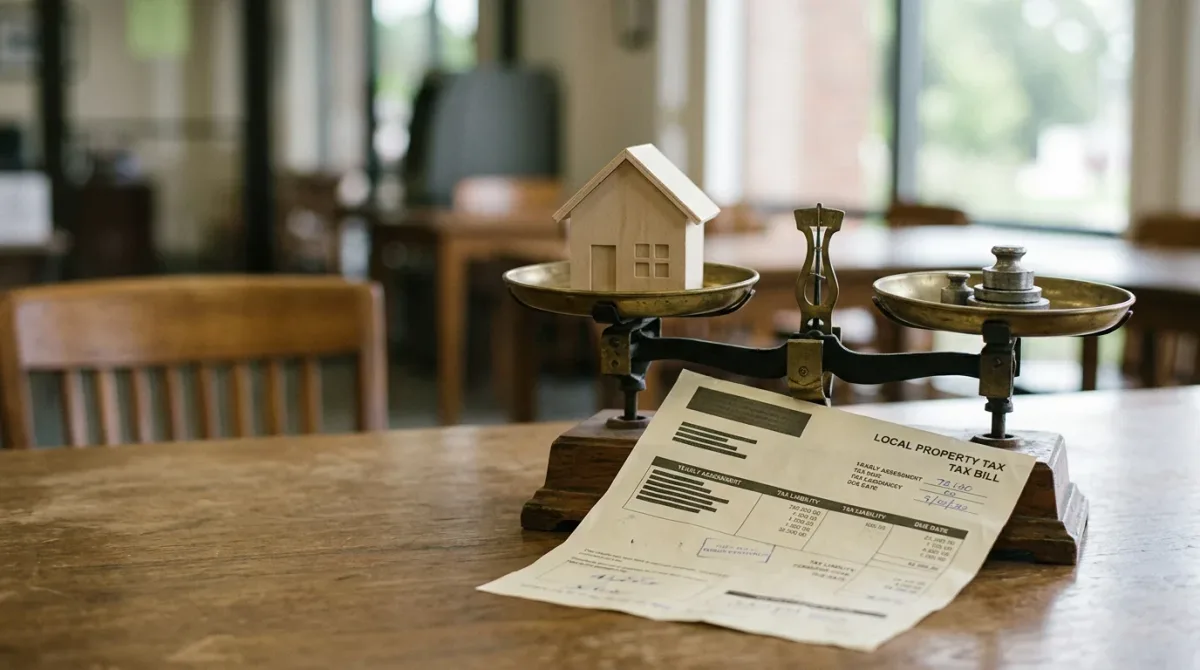
Union County property owners are receiving tax bills this month built on values that rose sharply last year: the median home value climbed to $403,000 from $293,377 in the county's last revaluation cycle, a jump of about 37%, according to the county's 2025 reappraisal results. The bills, mailed in mid-August, apply a tax rate of 43.42 cents per $100 of assessed value for fiscal year 2025-2026, per the Union County Tax Administration Office.
The higher values did not come from a fresh appraisal of every parcel this year. State law requires North Carolina counties to reappraise property at least every eight years, and Union County's most recent full revaluation was effective in 2025, following a prior cycle in 2021, per the county's Property Reappraisal page. For 2026, only parcels with physical changes — new construction, additions, demolitions, renovations, rezonings, or acreage changes — receive updated notices; everyone else keeps the 2025 value until the next scheduled cycle.
What actually changed in the 2025 revaluation
The county reappraised 114,182 parcels in 2025, up from 104,057 parcels counted in the 2021 cycle, reflecting continued new construction across the county, per the Tax Administration Office. Total taxable value across all property types rose to $60.05 billion from $32.38 billion, a 60.05% increase. Residential property values rose 63.45% and commercial and industrial values rose 45.59%, according to the same county figures.
A revaluation resets what a property is worth on paper for tax purposes; it does not by itself raise or lower how much money the county collects. County commissioners set the rate separately, and North Carolina law requires counties to calculate and publish a "revenue-neutral" rate alongside whatever rate they actually adopt, so residents can see how the new rate compares to one that would raise the same total revenue as before reappraisal. Whether the adopted 43.42-cent rate is higher, lower, or roughly equal to that revenue-neutral figure was not detailed on the pages reviewed for this article.
Residential and commercial property did not move together. Residential values rose 63.45% countywide, while commercial and industrial values rose a smaller 45.59%, per the Tax Administration Office's 2025 figures. That gap matters for how the tax burden is distributed after a revaluation: when home values rise faster than business values, homeowners as a group carry a larger share of the county's total tax base than before, even if the countywide rate stays flat. The county's published figures do not break the residential total down by municipality, so how much of that 63.45% landed in Indian Trail versus Waxhaw versus the unincorporated county is not stated in the source reviewed here.
The parcel count itself tells part of the growth story. Union County counted 114,182 taxable parcels in the 2025 cycle, up from 104,057 in 2021 — nearly 10,000 more taxable properties in four years, per the same county data. New parcels from subdivisions built after 2021 enter the tax rolls at current, higher values from day one, while older homes catch up only when the countywide revaluation resets them. That is one reason a homeowner in an established Monroe neighborhood and a buyer who closed on a new Weddington or Indian Trail build the same year can see very different jumps on their bills under the same tax rate.
Why the state requires this on a schedule
North Carolina General Statute 105-286 sets the octennial reappraisal cycle: counties must revalue property at least every eight years, and counties with populations above 75,000 must move sooner if their sales-assessment ratio falls outside a state-set range of 0.85 to 1.15. County commissioners can also vote to reappraise more often than the eight-year minimum. The statute is the same rule that produced Union County's 2021-to-2025 cycle and will govern whenever the county's next full revaluation is scheduled.
The mechanism exists because assessed values drift from real market prices between revaluations. In a county adding new subdivisions across Indian Trail, Waxhaw, and Weddington every year, homes built or sold after a revaluation can sit at very different value-to-price ratios than older homes nearby until the next cycle catches up. The periodic reset is meant to keep the tax burden distributed according to current market value rather than value from years earlier.
How the appeal window worked
Owners who believed their new value was wrong had a formal appeal path. For the 2025 cycle, the county mailed notices of new values in March 2025, and the Board of Equalization and Review heard appeals from April through July 2025, with a filing deadline of May 28, 2025, according to the Tax Administration Office. Tax rates were adopted in June 2025, and bills based on the new values went out in August 2025.
For 2026, the appeal window opened January 1 and closed when the Board of Equalization and Review adjourned on May 6, 2026, per the same county source. That window applied to parcels with a 2026 change in value — the new construction, additions, and other physical changes that generate a fresh notice outside the normal revaluation year. Owners who miss a given year's appeal deadline generally must wait for the next value change or the next countywide cycle to contest an assessment.
What this means for the August bill
For most property owners, the number on this month's bill reflects the value set in the 2025 cycle, not a new appraisal. The bill is due September 1, 2026, and becomes delinquent — carrying a 2% penalty for the first month and three-quarters of a percent for each month after — if it isn't paid by January 5, 2027, per the Tax Administration Office. The county's payment vouchers split the annual bill into four quarterly installments running from September through December, and owners who want a different payment arrangement must contact the Tax Office by mid-December.
The office collects more than county property tax on this bill: real estate and personal property tax, motor vehicle tax, gross receipts tax, and water, sewer, and landfill fees, plus tax billing for towns including Waxhaw, Marvin, and Marshville, are bundled into the same mailing, per the county's tax page. A resident confused about a specific line item is generally better served calling the Tax Administration Office directly than assuming the whole bill reflects a single rate change.
For a related community perspective, read How to speak at a Union County meeting, step by step.
For more context, read Monroe adds 8,000 residents, outpaces Union County growth.
For more context, read How Clarkstown homeowners get money back through STAR.
For more context, read The Five-Day Mandate and the Rebirth of Main Street.