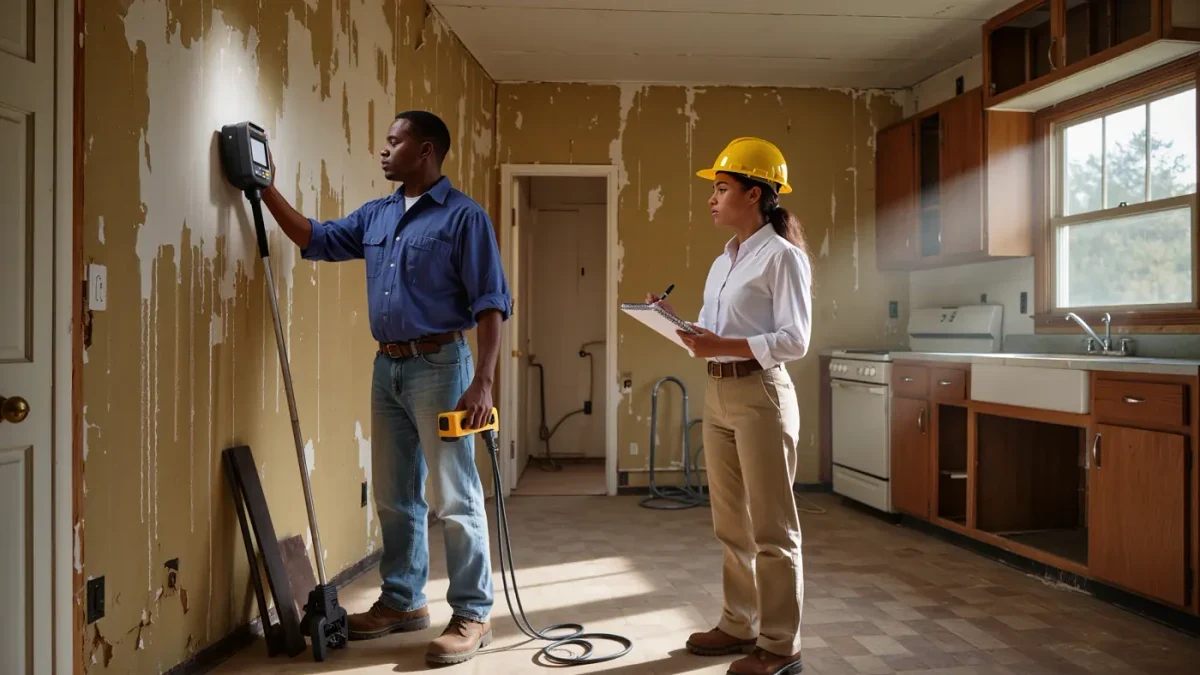
Distressed properties trade at a discount because they carry costs the discount is meant to repay: construction, time, and uncertainty. The investor's job is to convert an unknown cost stack into a priced one before closing. Where that conversion fails, the discount evaporates in overruns and idle carrying months, which is why the after-rehab arithmetic, not the list price, decides whether a distressed deal works.
Renovation lending terms are set by individual lenders.
What Counts as a Distressed Property?
Distressed, in practice, covers three conditions: physical distress — deferred maintenance, damage, systems at end of life; financial distress — a seller who must transact quickly, such as an estate, a pre-foreclosure, or a tired landlord; and title distress — liens, code violations, or unclear ownership that cloud transfer. The three can overlap, and each is discounted for a different reason: construction risk, speed risk, and legal risk.
The 70 percent rule is a common wholesaling heuristic: pay no more than roughly 70 percent of after-repair value minus repair costs. It is a bid heuristic, not a valuation, and it embeds an assumed profit margin and resale cost. Buyers who apply it as arithmetic rather than as a starting bid routinely overpay for properties whose repair estimates were optimistic.
How Should a Rehab Budget Be Built?
A rehab budget is built in two layers: a line-item scope priced by contractors who have walked the property, and a contingency line above it. Industry practice for older housing stock commonly carries 10 to 20 percent contingency, with the higher end justified when major systems — roof, electrical panel, plumbing stack, foundation — cannot be fully inspected before closing, per general contractor estimating practice as of 2024-2025.
The line items that break budgets are the invisible ones: sewer line replacement, knob-and-tube or aluminum wiring remediation, foundation underpinning, mold remediation following a long leak, and permit-triggered upgrades — when a jurisdiction requires bringing an entire system to current code once work opens walls. Code requirements are set locally, so the permit path in one city can change the scope a neighboring town would allow.
What Are Holding Costs and Why Do They Decide Margins?
Holding costs are the expenses of owning an idle property during rehab: mortgage interest, property taxes, insurance — vacancy-rated, which runs higher than an occupied-policy premium — utilities, and, where applicable, vacancy registration or security. They are pure time charges, so every week of overrun converts directly into cost.
An illustration on round assumptions: a $200,000 purchase with a $60,000 rehab financed so that debt plus carrying overhead costs roughly $2,000 a month carries a six-month plan at $12,000. A three-month overrun adds $6,000 and pushes total basis to $268,000 before selling or leasing costs. At that basis, the after-repair value the deal was underwritten to reach has moved further away, not closer. Holders without financing still pay the same costs as opportunity, since capital tied up in an idle asset has a price.
How Do Renovation Loans Change the Risk?
Renovation loans — the agency rehab programs for one-to-four-unit properties and their commercial counterparts — advance construction funds in draws against completed work. Draw schedules mean the borrower finances the project in stages rather than fronting the full rehab, but each stage requires inspection, and inspection cycles add time. Agency renovation programs carry down payment and contractor requirements set by program rules, per Fannie Mae and FHA renovation program guidance as of 2025.
The failure mode is the gap between draws and invoices: contractors often want payment ahead of draw release, leaving the investor to bridge the difference. A cash reserve beyond the official contingency — commonly several months of full carrying cost — is the standard defense, and lenders' own reserve requirements for rehab loans typically exceed those of standard purchase mortgages.
Which Distress Types Carry Which Legal Risks?
Legal risk varies by type of distress and by jurisdiction. Foreclosure and short-sale purchases follow state procedures with their own timelines and redemption periods — periods during which a former owner may reclaim the property — set by state statute. Estate sales can stall in probate, and probate practice is state law. Liens survive closing if not discharged, which is why title insurance and a full lien search are the buyer's main defenses; title rules and disclosure duties differ by state.
Properties bought at auction carry additional limits: typically no inspection contingency, sometimes no title search before bidding, and payment deadlines measured in days. The auction discount compensates for buying blind; buyers who assume inspectable-condition rights they do not have are paying for risks they have not priced.
How Do You Stress-Test the Full Distressed Deal?
A full stress test prices three scenarios, not one: the plan as bid, the plan with the contingency spent, and the plan with the contingency spent plus a defined time overrun. The deal's after-rehab rent or resale value comes from comparables dated at the exit, not at entry — and in submarkets with heavy new apartment delivery, where completions ran at multi-decade highs nationally through 2024, per Census Bureau data as of 2024, exit rent assumptions deserve conservative haircuts.
Financing costs ride on the rate environment the deal enters. Freddie Mac's Primary Mortgage Market Survey placed 30-year fixed rates near 6.9 percent at the end of 2024, per Freddie Mac as of December 2024, and higher-rate environments shorten the margin between a marginal distressed deal and a loss, because exit values capitalize at the prevailing yield.
The disciplined summary: distressed buying is a construction-management business wearing a real estate costume. Returns come from scope control, schedule control, and legal hygiene. Buyers who cannot exercise those controls are usually better served by already-renovated assets at transparent prices, where the discount they give up is the fair wage of whoever managed the rehab instead.
When Does a Distressed Deal Beat a Renovated One?
The comparison is a spread test: the discount to renovated value, minus the priced rehab, minus the contingency, minus the carrying cost of the longer timeline, minus the value of the buyer's own management hours. When that arithmetic leaves a margin materially above zero, distress pays for itself; when it does not, the renovated asset at a transparent price is the better deal, because someone else has already been paid to take the construction risk.
The buyers who clear the test consistently share three advantages: a contractor relationship priced before the offer, a lender already familiar with their file so draws start on schedule, and a market they know well enough to price the exit rather than hope for it. Buyers without those advantages can acquire the first two with time — a walkthrough and a bid before any offer is standard practice — but the third cannot be improvised, which is why distressed buying in unfamiliar metros fails more often than it succeeds.
A final discipline is walk-away frequency. Experienced distressed buyers bid on many properties and close on few, letting sellers' reserve prices filter the field. The single most common small-investor error is falling in love with one distressed property and negotiating the analysis until it agrees.