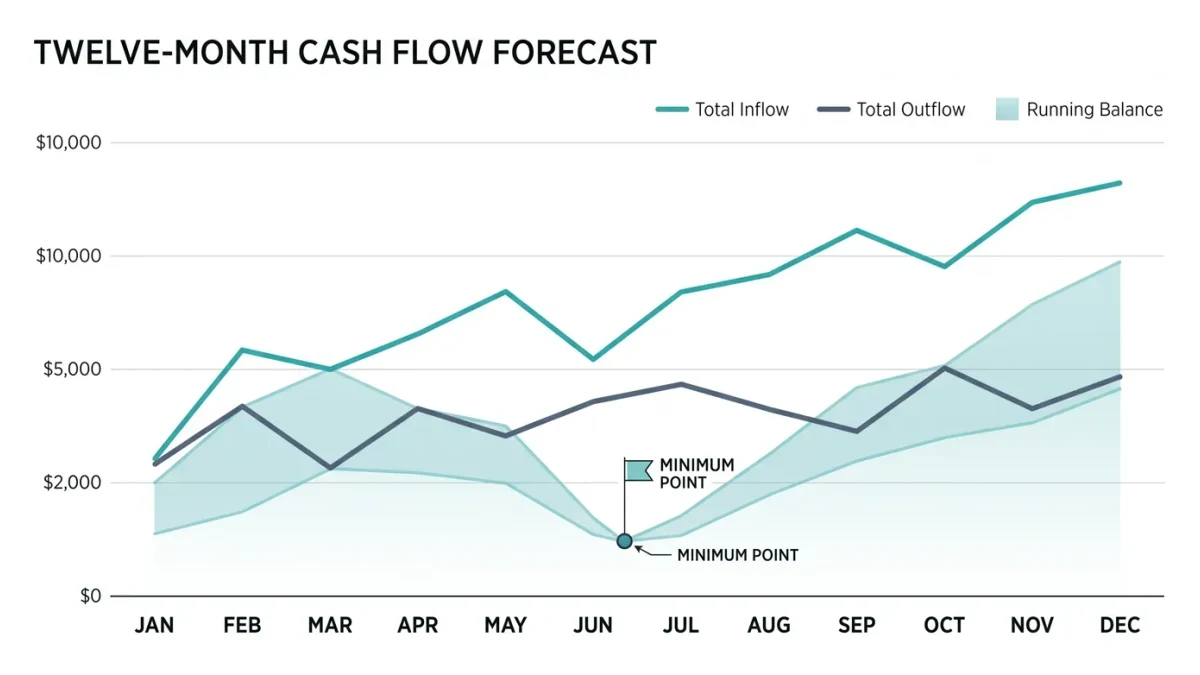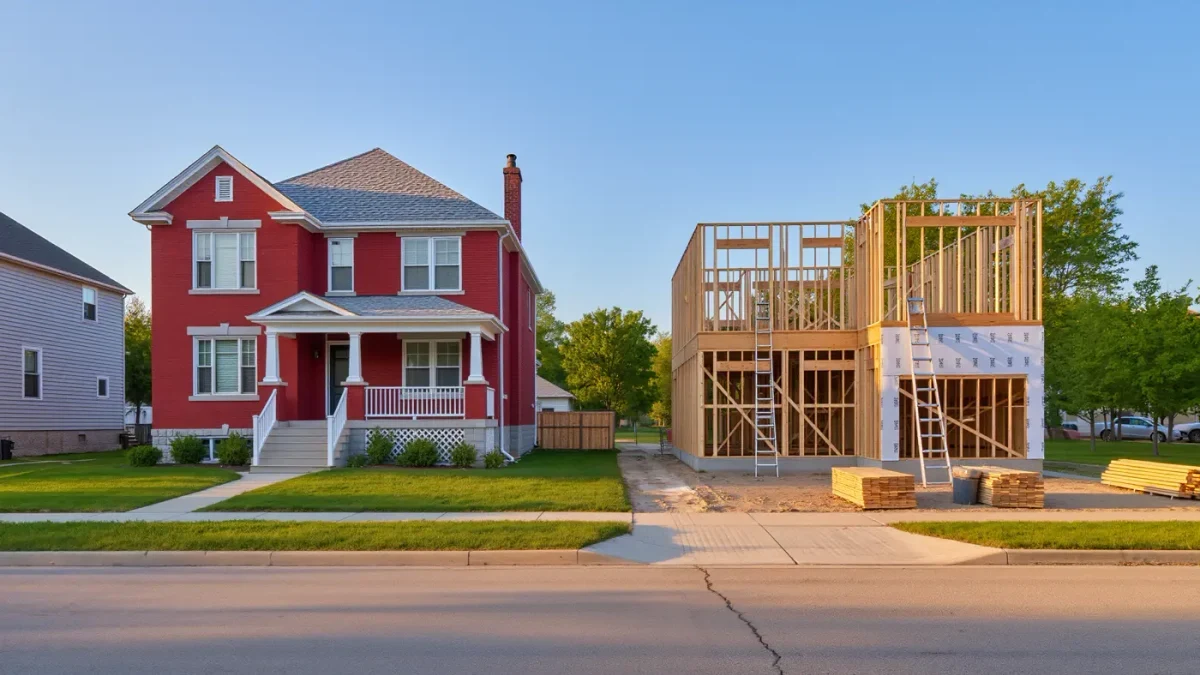
Cash-flow investing buys properties whose rent exceeds their costs, so the return arrives monthly. Appreciation investing buys properties whose value is expected to rise, so the return arrives once, at sale or refinance. The two labels sound like styles; in practice they are different businesses, with different financing requirements, different failure modes, and different demands on the owner's balance sheet and patience.
Figures are attributed and dated, and worked examples are illustrations on stated assumptions, not forecasts of any market.
What Does a Cash-Flow Property Actually Require?
A cash-flow property requires rent to cover operating costs and debt service with room to spare. The room to spare is the discipline: operating costs — taxes, insurance, maintenance, management, vacancy — commonly consume 35 to 50 percent of gross rent on older single-family stock, per common underwriting conventions as of 2024-2025, and anything not reserved becomes a future repair bill paid from a month that had no spare cash.
Debt service is the constraint that decides whether cash flow exists. At a 7 percent 30-year mortgage rate — a level recorded in Freddie Mac's Primary Mortgage Market Survey readings from late 2024 onward — each $100,000 of borrowed money costs roughly $665 a month in principal and interest. A property whose rent cannot carry that load at conservative reserves is not a cash-flow purchase at today's rates; it is an appreciation purchase wearing a cash-flow label, and the distinction should be admitted at underwriting rather than discovered at the first vacancy.
What Does an Appreciation Strategy Require?
An appreciation strategy requires the owner to carry the property while value does the work. Carrying means subsidizing negative or thin monthly cash flow from other income, holding through flat years, and financing the risk that the expected value increase arrives late or not at all. House price appreciation at the national level, as measured by the FHFA House Price Index, rose 4.7 percent between the fourth quarter of 2023 and the fourth quarter of 2024, per FHFA as of early 2025 — but that index has also recorded flat and negative years in specific markets, and the national average is not a property's return.
Appreciation also requires an exit plan with a date, because unrealized gain pays no bills. The strategy's returns are concentrated in a single transaction whose timing the owner does not control, which is why appreciation investing is, financially, closer to a concentrated illiquid position than to the monthly-income asset the rental label suggests.
How Does Financing Differ Between the Two?
Cash-flow buyers want fixed-rate, long-term debt, because a stable payment is what makes the surplus durable and forecastable. Appreciation buyers may accept shorter terms or floating rates, because their return case is not built from the monthly spread — a choice that adds refinancing risk in exactly the years when the exit might want to happen.
Leverage multiplies the difference. A property bought with 25 percent down moves the owner's equity roughly four times as much as the asset's value moves. In an appreciation strategy that gearing is the engine; in a cash-flow strategy it is a tolerance question, since the same gearing turns a modest value decline into a large equity decline while the monthly surplus stays small. The 2010s' low-rate environment made both strategies look identical because debt was cheap enough to fund both; the 2024-2025 rate environment separates them again.
What Are the Failure Modes of Each?
Cash flow fails slowly, through erosion: a rising tax assessment, an insurance repricing, a rent ceiling set by local incomes, or one major capital repair per year more than the reserve assumed. Each event is small; together they can turn a positive monthly surplus negative without any single dramatic moment.
Appreciation fails suddenly, through the exit: value that does not arrive, arrives for a different asset class than the one held, or arrives when the owner cannot wait. And the appreciation case carries a market-wide hazard the cash-flow case mostly avoids — when rates rise, the buyers' purchasing power falls and comparable prices compress, which is precisely the arithmetic that connected the 2022-2023 rate rise to the slowdown in national price growth visible in FHFA index data through 2023, per FHFA as of 2023-2024.
How Do Taxes Treat the Two Strategies?
Tax mechanics favor neither strategy uniformly but treat them differently. Cash-flow properties generate taxable rental income partially sheltered by depreciation, a non-cash deduction against the property's basis over a 27.5-year schedule for residential rentals, per IRS Publication 527 as of the 2025 tax year. The shelter is real but not unlimited — depreciation is recovered and taxed at sale, unless a 1031 exchange defers it, so cash-flow investors trade current tax relief for a future liability.
Appreciation investors hold most of their return as unrealized gain, untaxed until sale and deferrable through exchange, but they receive no depreciation shelter while carrying the property's negative cash flow. State-level treatment varies, and nothing here is tax advice; the point is that after-tax return comparisons between the two strategies require running each one's specific mechanics, not applying a single rule to both.
How Should an Investor Choose Between Them?
The choice is structural before it is market-based. An investor who needs the monthly income to service other obligations is buying a cash-flow asset or nothing, because an appreciation asset consumes rather than produces monthly cash. An investor with stable outside income, patience measured in years, and a tolerance for concentrated positions can carry appreciation risk — and should still demand the same verified numbers: dated comparables, actual taxes, realistic exit rents.
Many small portfolios end up blended: cash-flow assets in higher-yield, lower-growth markets funding the carry on appreciation assets elsewhere. That blend is a consequence, not a plan, when it happens by drift. As a deliberate structure it requires exactly what either strategy requires alone — reserves, fixed-rate debt where income depends on the payment, and assumptions conservative enough that the strategy survives a year when neither rent nor value cooperates.
How Do You Measure Whether Each Strategy Is Working?
Each strategy has an honest metric and a flattering one. For cash flow, the honest metric is actual cash-on-cash return: money received after all expenses, debt service, and reserves actually funded, divided by all capital invested. The flattering one is projected cash flow, which never includes the water heater. Tracking the gap between the two over the first two years tells an owner more about their underwriting than any spreadsheet does.
For appreciation, the honest metric is total return including the negative carry: value change minus cumulative subsidy, both realized at exit or measured honestly on paper with dated comparable evidence. The flattering version counts the gain and forgets the years of monthly support, which flatters the strategy by exactly the amount the owner transferred into it.
A quarterly habit serves both: reconcile actual income and expenses against the model, update the reserve balance to its funded level, and re-date the comparable evidence. Strategies drift silently — a cash-flow asset becomes an appreciation asset after one repricing event, and vice versa after a rent wave — and the drift is only visible when the two numbers are compared on purpose. What the data supports is the drift's direction; what it never supplies is the next year, and no metric should be asked for it.