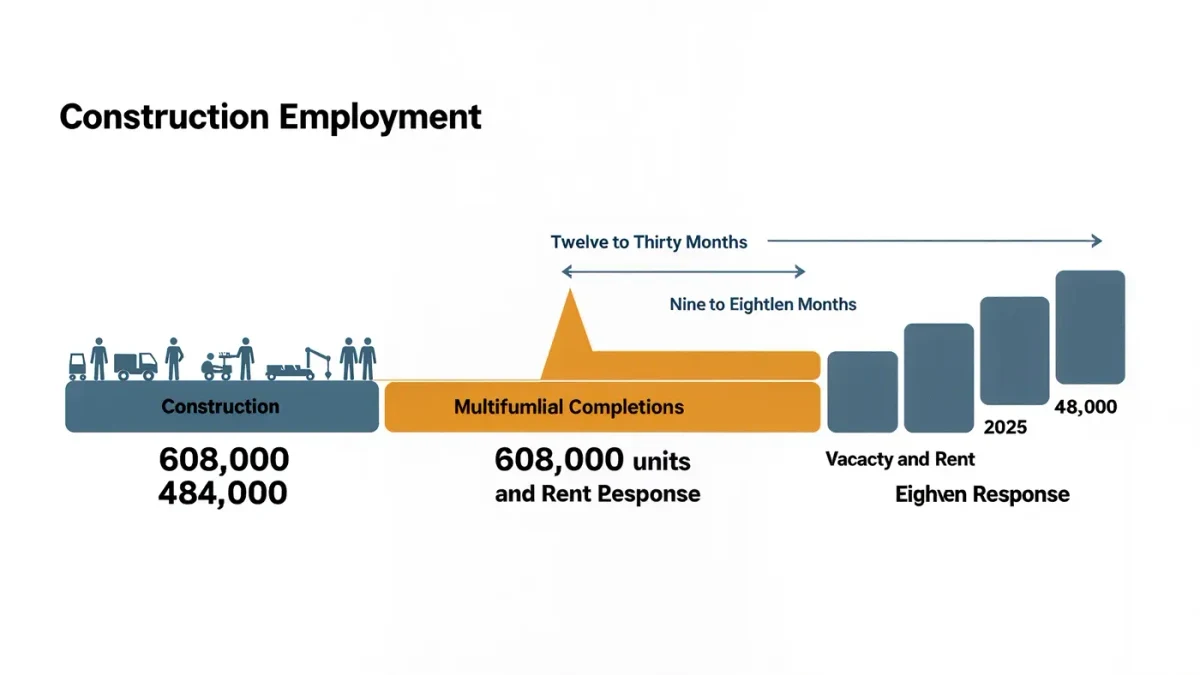
Construction employment is one of the earliest public signals of the rental supply cycle: the US construction sector employs millions of workers whose headcount moves with starts and completions, per the Bureau of Labor Statistics' monthly employment situation reports, and multifamily completions that peaked at roughly 608,000 units in 2024 before falling to about 484,000 in 2025, per Census Bureau construction data, imply a measurable easing of that work.
The connection runs through a simple chain: construction jobs track building activity, building activity becomes completions, and completions set the supply side of rent growth. Each link has a lag, and the lags are where careless readings go wrong.
What Does the Jobs Report Say About Construction?
The Bureau of Labor Statistics publishes employment, hours, and earnings for the construction industry each month in its employment situation release, with detail for residential specialty trade contractors — the framers, roofers, plumbers, and electricians whose workload is dominated by housing. Average weekly hours in residential trades are the sensitive line: firms cut overtime before they cut headcount, so hours lead employment by a month or two when activity turns.
The companion series that matters most to rental readers is the Job Openings and Labor Turnover Survey's construction openings count. Openings fall when builders stop scheduling future work, which happens when their pipeline of unstarted projects thins. Read together, hours measure today's workload and openings measure tomorrow's.
How Does Construction Employment Connect to Rents?
The chain has three timed segments. Employment reflects work underway today. Work underway becomes completions in twelve to thirty months for multifamily. Completions affect vacancy and rents a further nine to eighteen months out through the absorption lag. The full chain from a jobs shift to a rent shift runs two to four years, which is why monthly construction employment is a leading indicator for the rental market of the next decade's leases, not this year's.
The 2024-2025 cycle fits the template. Multifamily starts fell from their 2022-2023 peak as financing costs rose, per Census construction releases; completions peaked in 2024 at about 608,000 units, per NAHB's July 2025 tabulation of Census data, then fell to roughly 484,000 in 2025. Residential construction employment and hours eased over the same window, per BLS data — the labor market recording a pipeline that had already narrowed.
Which Parts of Construction Employment Should Rental Investors Watch?
Not all construction jobs are housing jobs. The industry aggregates heavy civil work — highways, utilities, data centers — with residential building, and nonresidential projects can hold employment steady while housing activity falls. The residential-focused cuts are residential building construction, residential specialty trade contractors, and the average hourly earnings for production workers in those groups.
Wages matter for a second reason: construction wages are an input to replacement cost, which feeds insurance premiums and renovation budgets. Rising trade wages make the same rehab cost more twelve months later — a direct, measurable link from the jobs report to a landlord's capital plan.
What Do Construction Jobs Say About Local Rental Demand?
There is a demand-side reading as well as a supply-side one. Construction employment is itself a local jobs engine: a metro adding thousands of construction workers is adding households that rent, usually near the work. During a heavy building cycle, the construction workforce partially absorbs the very units it builds — a self-feeding demand effect that ends when the pipeline ends, and the workers follow the next project to another metro.
A second-order effect compounds the first. Construction at scale draws supporting trades and suppliers into a metro, and those commercial commitments — supply yards, equipment depots, subcontractor offices — outlast individual projects. When the pipeline empties, the rental demand from those spin-off jobs fades too, adding another quietly deflating demand channel that the completion calendar predicts years in advance.
The demand signal is short-lived by construction's nature, and it is strongest in high-growth Sun Belt metros, the same metros that carried the heaviest 2024-2025 delivery loads. Netting the demand effect against the supply effect requires the completion calendar: while units deliver, both forces operate; once the pipeline empties, only the supply effect's aftermath remains.
How Should Readers Read the Next Employment Situation Release?
A disciplined monthly read takes four numbers in order: residential specialty trade employment, average weekly hours in that group, construction job openings from JOLTS, and multifamily units under construction from the Census Bureau's new residential construction release. Direction across all four, held for several months, is a signal; any single month is noise, and the BLS revises its first prints.
For a small landlord, the payoff from watching labor data is not trading timing — it is rehab budgeting and market selection. Trades availability shows up in bid spreads and completion calendars long before it shows up in national statistics, and a tight labor market for electricians shows up in an electrical bid first.
What Are the Limits of the Link?
The honest limits are three. Construction employment says nothing about demand from other sectors, which dwarfs construction's direct rental demand in most metros. The data is national and statewide, while rental conditions are submarket-level. And the chain's lags are averages, not schedules — a recession, a credit shock, or a permit reform can shorten or lengthen any segment. The jobs report is context for the supply outlook, and context does not price a property.