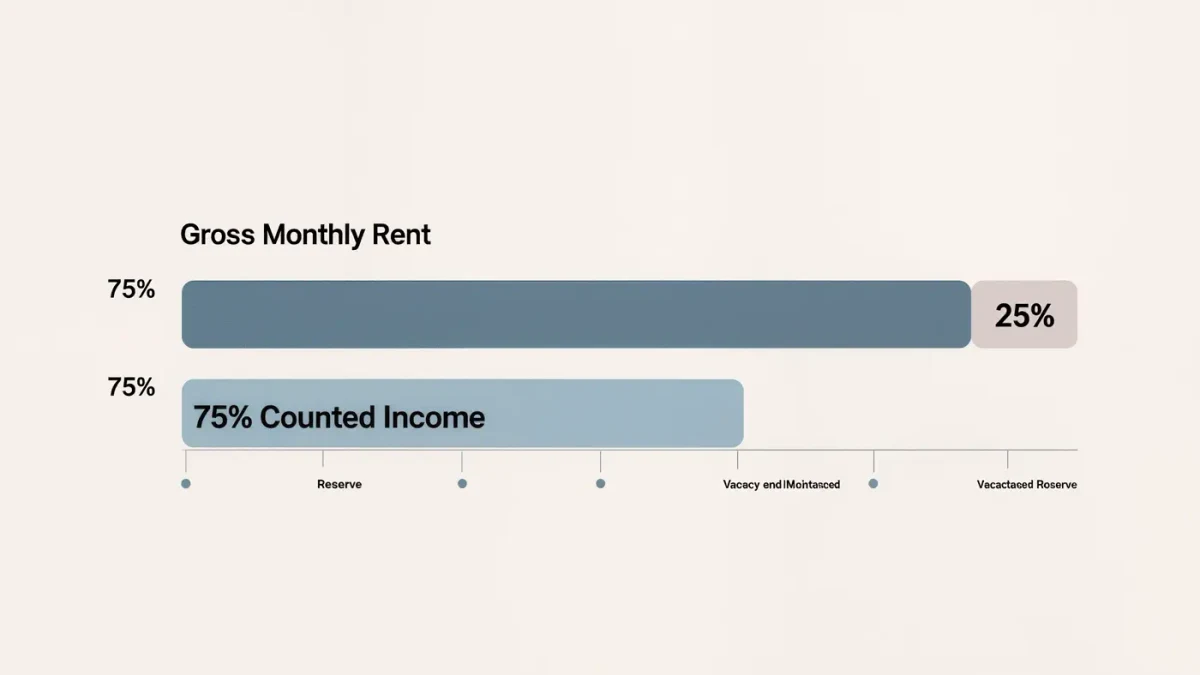
Lenders count rental income two ways: on a purchase or refinanced property not yet on a tax return, they use 75 percent of the lease amount or the appraiser's market-rent opinion, per the Fannie Mae Selling Guide as of 2025; on properties already held, they average what the borrower's Schedule E actually shows after expenses, which is usually less. Which method applies depends on how long the borrower has owned the property and whether the income has a documented history.
This site publishes information about underwriting mechanics, not lending or tax advice. Agency-guide terms cited below are as of the stated dates; lender overlays vary.
How do lenders count rent on a property being purchased?
The rule is the 75 percent haircut. For a one-unit investment purchase, the lender takes the lesser of the lease rent or the appraiser's Form 1007 or 1025 market-rent opinion and multiplies by 0.75, then counts the result as qualifying income; the 25 percent deduction covers vacancy and maintenance before the borrower ever sees the money. On a two-to-four-unit purchase, each unit's rent is treated the same way through the Form 1025 operating income statement.
The same treatment covers the house-hacking case with one boundary: rent counts only from units the borrower will not occupy. The unit the owner lives in contributes nothing, because it generates no rent.
The haircut is conservative by design and often surprises first-time investors. A $2,000-a-month lease yields $1,500 of qualifying income — $18,000 a year — which supports roughly $5,000 of additional borrowing at typical debt-to-income ratios. Modelers who gross up the full lease are working from a different arithmetic than the underwriter.
How is rental income counted on properties already owned?
Once the property appears on a tax return, agency underwriting switches to Schedule E, per the Fannie Mae Selling Guide. The lender starts with the rent reported, subtracts the expenses the borrower actually declared — taxes, insurance, repairs, utilities, depreciation — and adds depreciation back because it is a non-cash deduction, then averages the result across the number of months or years the return covers.
The switch matters because Schedule E nets to less than 75 percent of gross rent for many landlords, since real operating costs eat into the gross. A property that shows $24,000 of rent and $9,000 of expenses with $7,000 of depreciation produces about $22,000 of qualifying income on the guide's math — but one with heavy repairs in the averaging window can show far less, and recent losses offset other income dollar for dollar.
Timing rules govern the average. When the most recent return covers a partial year of ownership, the guide directs the lender to annualize and, where the property has been owned for a full tax year, to use the most recent Schedule E rather than an average. Borrowers mid-improvement — a heavy repair year followed by a stabilized year — should expect the weaker year to dominate the file.
What documentation does rental income require?
For lease-based income, the file needs the executed lease, evidence of security-deposit receipt or two months of rent payments where the tenant is already in place, and the appraisal's rent schedule. For return-based income, the file needs two years of personal returns with all schedules, plus K-1s where the property sits in a partnership or LLC taxed as a partnership — the K-1's income or loss flows into the analysis alongside Schedule E.
Short-term rentals follow a different track. Income from a property the borrower actively operates — an STR with material services — can be treated as self-employment income rather than rental income under agency guide provisions, which changes both the averaging and the documentation: profit-and-loss statements replace the lease. Where the STR is managed by a third party with limited services, it reverts to rental treatment.
Section 8 Housing Choice Voucher income counts as rent for these purposes, a treatment HUD has repeated consistently in its landlord materials; the lease and the housing-authority payments document it the same way a market lease does.
How does rental income affect debt-to-income ratios?
The income enters the numerator side of the DTI fraction, but the property's full payment — principal, interest, taxes, insurance, association dues — enters the denominator side whether or not the rent covers it. The netting is where files are won and lost: a property whose 75 percent haircut exceeds its PITIA improves DTI, and one whose does not drags it.
An illustration using the guide's rules: a duplex unit renting at $1,600 contributes $1,200 of income against, say, a $1,100 allocated payment, adding $100 of net monthly capacity. The same property at a $1,300 rent contributes $975 and subtracts $125. Identical buildings, opposite DTI directions, decided entirely by the lease and the appraisal.
Multi-property portfolios compound the effect. Every mortgaged rental nets separately under agency rules, which is why experienced borrowers stabilize a property for a full tax year before the next purchase: the Schedule E average, not the pro-forma, is what the next underwriter will read.
What reduces counted income below expectations?
Five deductions recur. Vacancy loss and concessions on the rent roll cut the gross before the haircut applies. Partial-year averaging dilutes strong recent months with weak early ones. Declared expenses on Schedule E reduce the net where returns are used. Unpermitted or illegal units contribute nothing regardless of actual rent collected. And long vacancy gaps — a turnover between lease and closing — can leave the underwriter with the market-rent opinion rather than a lease, which is usually lower.
The corrections are equally concrete: signed leases with deposit trails, permits for every counted unit, clean operating statements, and timing that lets stabilized income age into a filed return. None of this improves the property; all of it improves the file.
Do all lenders use the same rental income rules?
Agency lenders — the Fannie Mae and Freddie Mac pipelines that carry most residential volume — use the rules above, with minor documented differences between the guides. Portfolio lenders and banks underwrite to their own credit policies, often more conservative on new acquisitions and sometimes more flexible on seasoned portfolios with strong deposit history. DSCR lenders dispense with personal-income counting entirely and size the loan against the property's rent, which is a different product rather than a looser version of the same one.
The practical sequence for a borrower is fixed: decide the product first, because the product decides which income math applies, and only then model the ratios. Running agency arithmetic on a DSCR plan, or the reverse, produces numbers no underwriter will ever see.
The summary is short enough to keep. New purchase: 75 percent of documented rent. Seasoned holding: Schedule E with depreciation added back. Either way, the underwriter's arithmetic starts from documents, not from the borrower's spreadsheet, and files built to match the documents close faster.