Property tax is the operating expense a rental owner cannot shop for, negotiate, or defer, and in much of the country it resets the moment a property sells. An investor who underwrites a purchase using the seller's tax bill inherits a number that may apply only until the next assessment cycle. Because the tax recurs every year for the whole holding period, small errors in the assumption compound into large changes in lifetime return.
This is an explanation of how property tax mechanics affect rental math, not tax advice. Rules vary by state and county; every claim below names its jurisdictional level, and figures are attributed and dated.
Why Do Property Taxes Reset at Sale?
Assessment method is state law. In some states, most visibly California under its constitutional assessment limits, a property's assessed value is capped and resets to market value only on transfer, which means a long-held property can carry a bill far below what its price implies; the buyer's first full-year bill is computed on the sale price, per California assessment rules as of 2025. In the majority of states, assessments track market value on a rolling cycle, so the reset at sale is partial — a step toward the new price rather than a jump to it.
The underwriting consequence is identical in both cases: the correct tax assumption for a purchase model is the tax implied by the sale price under the local rate and assessment rules, not the figure on the current bill. The county assessor's office will state the method; many counties publish an estimate-before-purchase service precisely because buyers ask.
How Much Can the Gap Be?
The gap depends on how long the seller held and how the jurisdiction reassesses. Where reset-on-sale rules apply, the difference between a decades-old assessment and a market-price assessment can be several-fold — a bill that multiples on closing is common enough in reset states to warrant its own line in every pro forma. In rolling-assessment states, the change is smaller but still material in markets where prices rose quickly, because assessment cycles lag the market by one to three years, per typical county assessor practice as of 2024-2025.
An illustration on round numbers shows the cap-rate effect: a $300,000 rental with a $9,000 annual tax bill carries a 3 percent effective rate. If the buyer's model used a seller's legacy $3,600 bill, the error overstates net operating income by $5,400 a year — on a 6 percent cap rate, that is $90,000 of implied value, nearly a third of the purchase price. The arithmetic is why tax verification precedes any offer in disciplined underwriting.
What Drives Tax Bills Over the Holding Period?
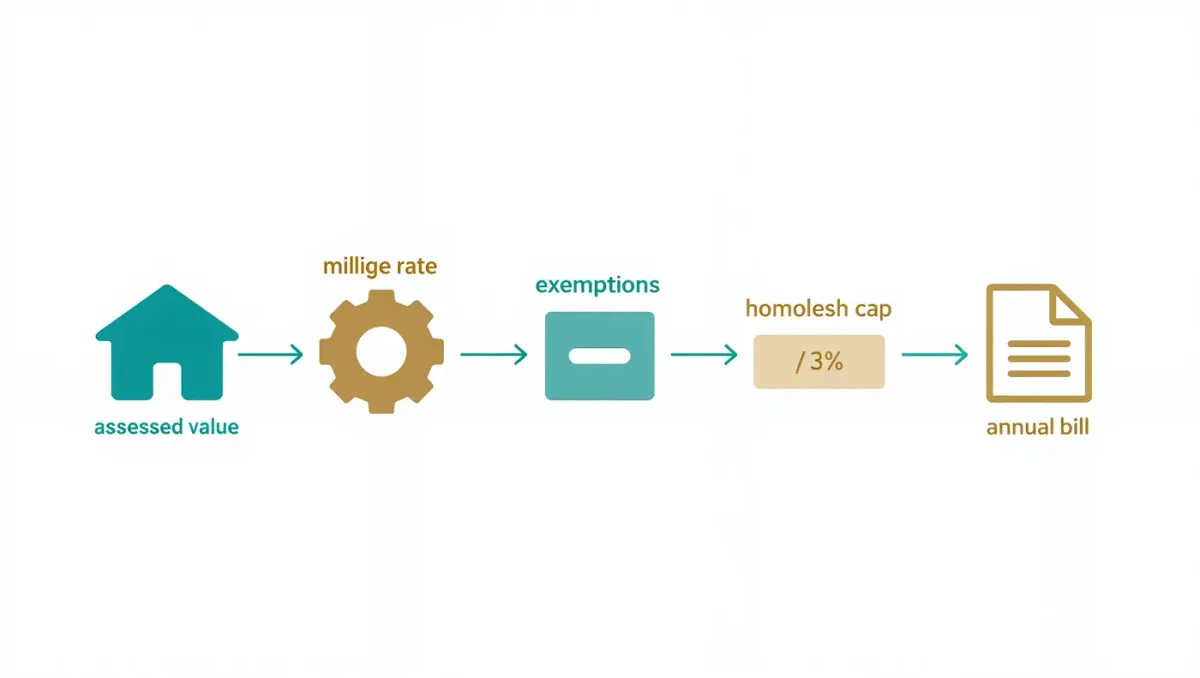
Three drivers move a bill after purchase: the tax rate set by local governments, the assessed value's path, and any caps or exemptions the state allows. Rates are set by thousands of overlapping local bodies — counties, school districts, cities — and change with their budgets, so a market's historical rate stability is a checkable fact through the assessor's published levy history. Caps on assessment growth exist in many states and limit annual increases for continuing owners; homestead exemptions generally do not apply to investor-held property, per state exemption rules as of 2025.
National context matters for rate pressure. Local revenue needs have collided with insurance cost inflation for governments as well as landlords in recent years, and voters in high-tax states have shown both directions — rate increases and statutory limits — on ballots. The direction of a specific market's property tax trajectory is a local question, answerable from the county's own levy records, not from national commentary.
How Do Taxes Interact With Rent and Value?
Property tax enters net operating income directly, and net operating income is what a property's value capitalizes. A permanently higher tax bill either reduces the owner's return or must be passed into rent — and rent is constrained by local incomes, per rent-to-income data in the American Community Survey, Census Bureau, as of 2025. In markets where tax burdens rise faster than rents, the gap comes out of the owner's yield and, eventually, out of the asset's resale value, because the next buyer capitalizes the same higher expense.
This is why effective tax rate — annual tax as a share of market value — is a standard cross-market comparison metric. Effective rates vary widely across states, from well under one percent to above two percent of value in the highest-tax states, per Tax Foundation effective-rate analysis as of 2024-2025. A two-point difference in effective rate is a two-point difference in the cap-rate starting point between markets, which no amount of management skill recovers.
What Can an Owner Do About a Rising Bill?
The tools are procedural and jurisdiction-specific: assessment appeals, where the owner contests the assessed value with evidence of comparable sales or income; classification challenges where the property is misclassified; and, where available, exemptions that do apply to rentals. Appeal windows are short and set by county rule, and success depends on evidence, not argument, per county appeal procedures as of 2025.
Appeals also carry a two-sided risk owners should know: appealing on the basis of rental income implicitly documents the property's income for the assessor, and jurisdictions differ in how income evidence is treated. The decision is worth making deliberately, per local rules, before filing.
How Should Taxes Enter Underwriting?
The habit is three lines, not one: the current bill as documentation, the post-sale estimated bill as the operating assumption, and the levy history of the taxing bodies as the trend. Where the jurisdiction resets on sale, the estimated bill is computed from the price; where assessment rolls, it is estimated from the assessor's cycle. The trend line guards against modeling a one-year bill as a constant.
Property tax is the least glamorous line in rental analysis and among the most durable: it is senior to the mortgage, immune to vacancy arguments, and recalculated on the very transaction that creates the ownership. Investors who price it precisely buy the return they modeled; investors who inherit the seller's bill buy a number that expires with the seller's ownership.
How Should Investors Compare Tax Burdens Across Markets?
Comparing tax burdens across markets requires normalizing to value, and that is what the effective rate does: annual tax divided by market value, expressed as a percentage. Nominal rates — the millage printed on a bill — mislead across jurisdictions because assessment ratios, equalization practices, and caps differ; the effective rate collapses all of that into the number that actually hits the pro forma, per Tax Foundation cross-state analysis as of 2024-2025.
The comparison belongs next to the rent the market supports, not on its own. A high effective-rate market with strong rents can net better than a low-rate market with weak ones: what matters to the owner is the tax bill as a share of gross rent, which combines the effective rate with the price-to-rent ratio in a single readable line. Computing it takes the county bill estimate and one year of verified rent, and it ranks any shortlist of markets in minutes.
One caution keeps the comparison honest: effective rates are measured on owner-occupied housing in most published series, and investor-held property can face different classifications or exemptions by state. The final input should always be the county's own answer for the specific parcel class, not the published state average.