Tenant screening is legal in every state, but two federal frameworks govern it: the Fair Housing Act, enforced by the Department of Housing and Urban Development, and the Fair Credit Reporting Act, enforced by the Federal Trade Commission. Both reward the same practice — one written standard, applied identically to every applicant, documented as of 2026 rules on hud.gov and ftc.gov.
This is information about how screening law works, not legal advice. Landlord-tenant and fair-housing rules vary by state and city, and several localities add source-of-income protections that federal law does not include.
What May a Landlord Legally Consider in a Tenant Application?
Landlords may lawfully consider income and employment, credit history, rental history, references, and criminal records within limits the HUD guidance set in 2016 and still applied in 2026. What they may not do is consider race, color, religion, national origin, sex, familial status, or disability — the seven protected classes of the Fair Housing Act. Many states and cities add more protected classes, such as age, marital status, voucher income, or sexual orientation.
The practical test is consistency. If a landlord verifies income for one applicant, it verifies income for all of them. If it accepts a two-year rental history, that threshold applies to every file. Ad hoc decisions are where discrimination claims start, because a rejected applicant only needs to show differential treatment to open a HUD complaint.
Income screens deserve specific care. The widely used rent-to-income threshold of three times monthly rent is a market convention, not a federal requirement. Where a voucher covers part of the rent, some jurisdictions require counting the voucher as income for the ratio — HUD publishes a state-by-state summary of these source-of-income laws, and a landlord that ignores it in a covered city has exposure regardless of intent.
How Does the Fair Credit Reporting Act Apply to Screening Reports?
When a landlord buys a tenant-screening report from a consumer reporting agency, the Fair Credit Reporting Act applies, and its two obligations are notice and accuracy. The FTC, which enforces the statute, summarized both duties in its consumer-credit guidance updated through 2025.
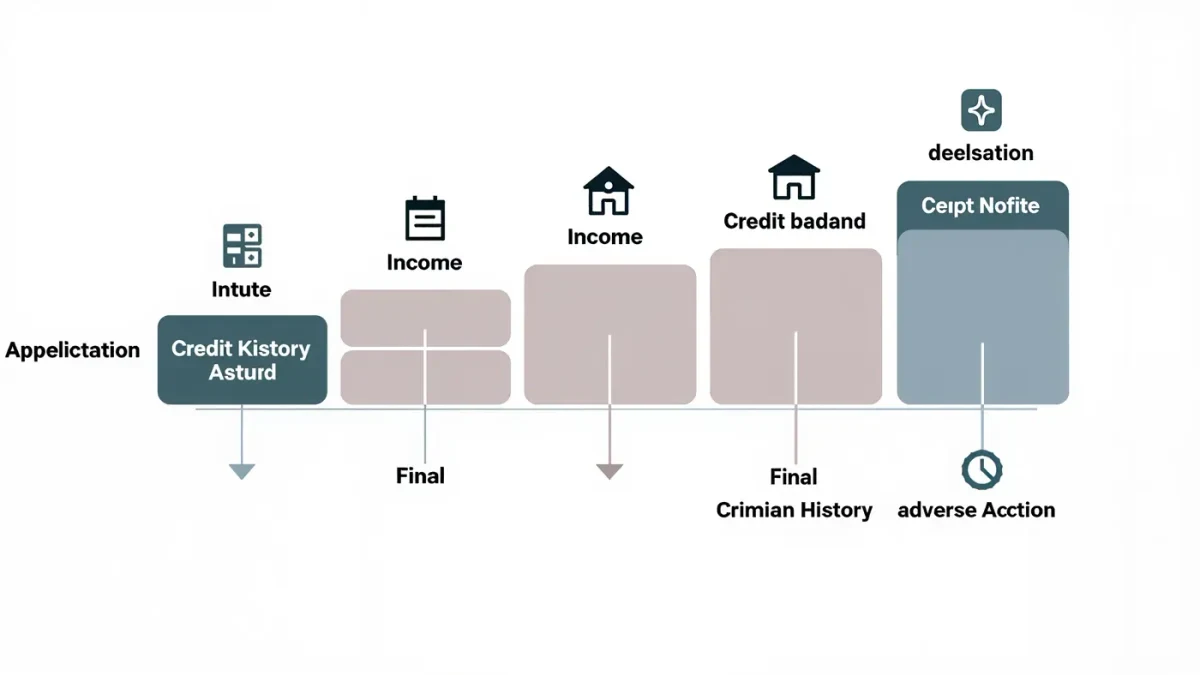
Before pulling a report, the landlord typically needs the applicant's written permission. After the report, two triggers matter. First, if the landlord takes an adverse action — a denial, a higher deposit, or a co-signer demand — it must tell the applicant in an adverse action notice that names the screening bureau, provides its contact details, and states the applicant's right to a free copy and to dispute errors. Second, the notice must be given within a reasonable time, which the FTC and courts have read as shortly after the decision.
The screening report itself is only as good as its matching. Screening bureaus often match on name and address, and mismatches produce wrong records. That is a documented problem: the FTC has brought enforcement actions against tenant-screening firms over inaccurate reports, including a 2023 case against a bureau for failing to properly investigate disputes. A landlord that denies based on a report should keep the notice and the report, because disputes arrive after move-in dates have passed.
Can a Landlord Reject an Applicant Over a Criminal Record?
A blanket ban on any criminal history is unlawful under the HUD guidance issued in 2016, which remains the operative federal standard in 2026. The guidance treats a categorical exclusion as having a disparate impact on protected groups. What survives is individualized assessment: the nature of the conviction, how long ago it occurred, and its relevance to tenancy.
Arrest records are not convictions and should not be treated as grounds for denial under the HUD framework. Some states go further — for example, rules limiting how far back a landlord may look, or restricting the use of certain record types entirely. The jurisdiction has to be named in any policy: a policy written for one state may be unlawful in the next.
A defensible written policy reads like a matrix, not a judgment call. It lists which convictions are relevant to housing risk, within what lookback window, and what evidence of rehabilitation or mitigating circumstances the landlord will consider. HUD's own testing program looks for consistency across applicants, and a matrix is the cheapest defense a small landlord can build.
What Should a Written Screening Standard Contain?
A written standard should contain five elements: the income threshold and what counts as income, the minimum credit standard or score band, the rental-history requirement, the criminal-history policy with its lookback and individualized-assessment language, and the order of processing — first qualified applicant, or earliest complete application. Processing order is increasingly the litigated question, because fair-housing testers compare who gets called back.
- Income: a stated multiple of rent, applied to verifiable income, with the local source-of-income rule checked on hud.gov before publishing the standard.
- Credit: either a named score band or named derogatory events, never a reviewer's overall impression.
- Rental history: a fixed number of years and a fixed list of disqualifying events, such as a prior eviction for cause.
- Criminal history: the HUD-compliant individualized assessment described above.
- Documentation: every decision logged with the date, the criterion met or missed, and the adverse action notice sent.
The standard should be finished before the unit is advertised. Retroactive standards are how a landlord turns a routine denial into a discrimination claim, because the timeline shows the rule moved after a particular applicant appeared.
What Documentation Protects a Small Landlord if a Complaint Is Filed?
The documentation that matters is the application, the screening report, the decision log, and the adverse action notice — kept together, dated. If a complaint reaches HUD or a state equivalent, the landlord's defense is consistency evidence: every applicant in the same period, the criteria applied, and the outcome. HUD's complaint process, described on hud.gov, allows a year to file, so files should be kept well beyond the leasing season.
Records also protect against screening-bureau errors. If a denied applicant disputes a record and the bureau corrects it, the landlord may face a second decision point — and the corrected file is the only proof of what the first decision rested on.
How Do Screening Criteria Interact With Voucher and Source-of-Income Rules?
Source-of-income protections decide whether a voucher counts as income, and they are the fastest-moving layer of screening law. Federal law does not require accepting vouchers — the Fair Housing Act's protected classes do not include income source — but dozens of states and cities have added protections that do, and HUD's state tenant-rights pages summarize current state rules as of 2025.
In a covered jurisdiction, the income test applies to the tenant's portion plus the voucher's payment, which can flip a three-times-rent screen from fail to pass. A landlord that applies a gross-rent ratio to a voucher household in a covered city has made an actionable error even with a uniformly written standard.
The verification workflow also differs. Voucher tenancies add a housing-authority inspection and a housing-assistance-payment contract to the timeline, so processing order and unit-condition standards need to account for steps the landlord does not control. Landlords that decline voucher participation should confirm the jurisdiction permits it before acting — and should record the lawful basis, because testers probe this question frequently.
Where the rules stop: nothing here resolves a specific dispute, and a landlord facing a filed complaint needs a lawyer in that jurisdiction. What the federal frameworks do establish is process — one standard, applied uniformly, with the notices sent. The data on outcomes is thin, but the pattern in HUD enforcement materials is consistent: inconsistent process, not bad intent, is what most cases turn on.