Rent-reporting services transmit rent payment records to credit bureaus or specialty consumer-reporting databases, and their rise sits on a documented base: the Federal Trade Commission, which enforces the Fair Credit Reporting Act, counts hundreds of millions of credit-invisible or unscorable consumers in materials published through 2024 — a population rent reporting is explicitly designed to reach. For landlords, the services promise on-time payment incentives and a softer collection lever; the mechanics and the limits below are what the decision actually turns on.
This is information about how rent reporting works, not credit or legal advice. FCRA obligations and state rules on payment-data handling apply to any landlord who adopts a service.
How Does Rent Reporting Actually Work?
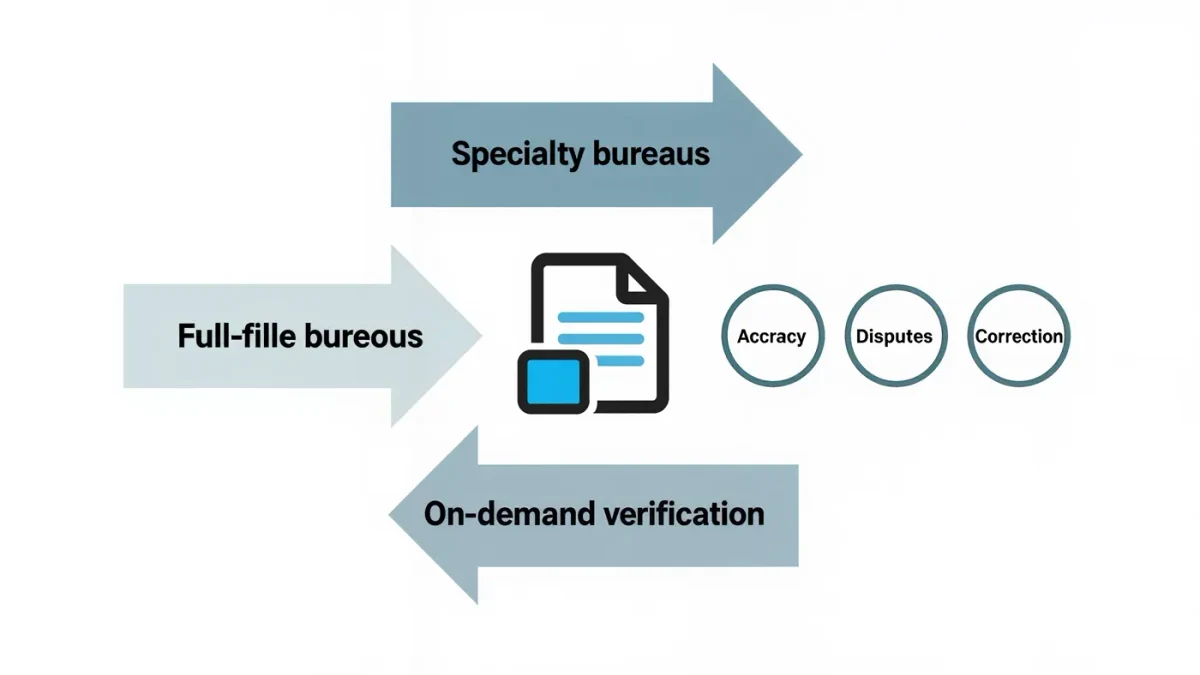
Rent reporting works in one of three technical routes: full-file furnishing to the three nationwide bureaus, which can affect traditional scores; specialty-bureau reporting, which lenders can pull but which does not move mainstream scores; and rent-payment verification services, which report only on demand for a specific application. Which route a service uses determines what a tenant's on-time rent actually does to their credit profile.
Furnishing is a regulated activity. Under the FCRA and its Furnisher Rules, entities that furnish data to consumer reporting agencies must be accurate, must investigate disputes, and must correct errors — the FTC's furnisher guidance, current through 2024, is the controlling framework. Some services take on furnishing compliance themselves; others offload verification to the landlord, which transfers obligation along with it. A landlord adopting a service should know which side of that line the contract places them on.
Data input is the weak link. Most services verify payments through bank connections, platform payments, or landlord confirmation, and each method fails differently — bank connections misread transfers, and landlord-confirmed data is only as clean as the landlord's ledger. Under the FCRA, a disputed tradeline must be investigated, so sloppy input eventually returns as work.
What Are the Claimed Benefits, and What Is Actually Documented?
The documented benefit is score movement for thin-file tenants: studies collected by federal financial-regulator working groups through 2024, including materials from the interagency effort on alternative credit data, consistently find that including positive rent payment history lifts scores for credit-invisible renters while leaving thick-file borrowers roughly unchanged. The direction is well supported; the magnitude varies by study and scoring model.
The landlord-side claims — improved on-time payment and softer collections leverage — are largely vendor-reported, and this publication treats them as company claims, not independently verified findings. The mechanism is plausible: reporting gives on-time payment a positive consequence and late payment a visible one. But no public dataset tracks delinquency before and after adoption at scale, so any specific improvement number a vendor cites should be read as their own figure.
For tenants, the benefit is asymmetric in a way landlords should understand before marketing it: positive history helps thin-file renters build credit, while reported late payments or collections can damage the same file. A service that reports only positives delivers the upside without the downside; full-file reporting delivers both.
What Consent and Disclosure Rules Apply?
Consent and disclosure rules come from the FCRA and from state law. Furnishing data generally requires the tenant's authorization under the service's own enrollment flow, and lease language adopting reporting should state what is reported, to whom, and both directions — positive and negative — where full-file reporting is used. Mid-lease adoption raises the same consent question again: material changes to lease terms generally require agreement or proper notice depending on jurisdiction.
Adverse-action obligations carry over. If a landlord denies or conditions an application based on a rent-payment history report from a specialty bureau, the FCRA's adverse-action notice applies — the same notice, naming the same bureau contact details, that applies to traditional screening reports, per FTC guidance.
Dispute handling deserves a written path before adoption: who receives a tenant's dispute, who investigates, in what window. The FCRA sets investigation timelines for furnishers, and a small landlord without a process will discover the timeline from the dispute itself.
Where Do Rent-Reporting Services Fall Short?
The shortfalls are structural. Mainstream mortgage underwriting's treatment of rent history is uneven — some programs factor verified rent payment into qualifying, others do not, and a tenant building a rent tradeline may find that not every lender reads it. Score-model treatment varies the same way: some models incorporate the tradeline, others ignore it.
For landlords, reporting is not a collection system. A late-payment tradeline does not produce payment, and the actual collection mechanics — notice, late fees under state law, and the eviction process — remain what they were. The service changes the tenant's incentive structure, not the landlord's remedies, and owners who adopt reporting expecting collection leverage tend to overestimate it.
Finally, the tenant-protection boundary: several states and cities have considered or adopted limits on how landlords may use payment-data services, particularly around involuntary or negative reporting. As with deposit rules, the jurisdiction check precedes the policy.
How Should a Landlord Evaluate a Rent-Reporting Vendor?
Evaluate a vendor on five questions: which route it uses — full-file, specialty, or on-demand verification; who bears furnishing compliance under the FCRA; what consent flow it uses and what lease language it requires; how disputes are handled and within what timelines; and what it costs, to whom — landlord-paid, tenant-paid, or split. A sixth question, unstated in most vendor material: does it report negative data, and is that consistent with what the lease says?
How Does Rent Reporting Interact With Subsidized Tenancies?
Subsidized tenancies complicate reporting because payment under a voucher contract splits between tenant portion and housing-authority payment, and a service that records only what the tenant pays can misread on-time performance. Some platforms handle split payments natively; others do not, and a tradeline built on partial data is exactly the kind of accuracy problem the FCRA's furnisher rules exist to prevent.
The lease and the housing-assistance payment contract together define what is owed and when, so the reporting input should trace to that combined schedule rather than to the ledger's tenant column alone. Where a service cannot ingest authority payments, the landlord should either verify the tradeline's basis or decline reporting that tenancy.
For tenants in subsidized housing, the credit-building upside is at its largest — thin-file renters are overrepresented — so the service choice matters to exactly the households the technology was built for. Landlords adopting reporting across a mixed portfolio should ask vendors the split-payment question before enrollment, not after a dispute.
The adoption order matters less than the consent hygiene: disclose in the lease, enroll with affirmative consent, keep the ledger clean enough to survive a dispute, and route any adverse decision based on reported data through the standard notice. A landlord who does those four things stays on the paved road the FCRA built.