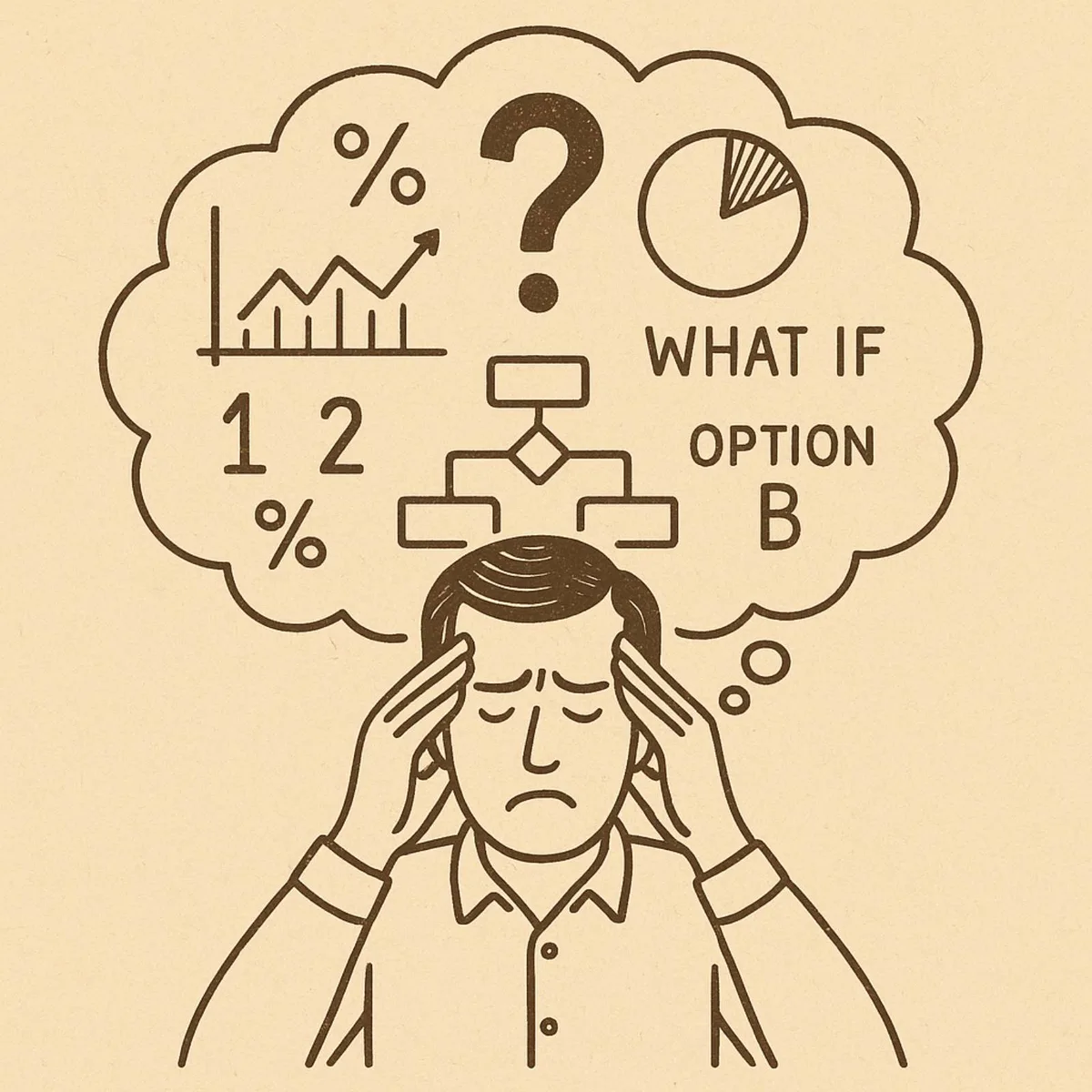
Analysis paralysis is the stall that happens when a decision-maker keeps gathering information instead of choosing. The problem is rarely a shortage of analysis. It is the absence of a stopping rule — no agreed point at which the work ends and the decision begins. In property underwriting the pattern is familiar: a third rent comp, a fourth expense scenario, a fifth broker package, and the deal window closes while the spreadsheet stays open.
The fix is structural, not motivational. Set a deadline before the research starts. Define in advance what a good-enough answer looks like. Then pick the first option that clears that bar. Psychologists call the second move satisficing, and it works because it converts an open-ended search into a bounded one. This is information about how decision-making works, not advice on any specific deal.
The word itself has older roots than the modern affliction. According to Wikipedia, analysis means breaking a complex topic into smaller parts to understand it better, a practice applied in mathematics and logic since before Aristotle. The method is sound. The failure mode appears when the breaking-up never stops and the parts are never put back together into a judgment.
What is analysis paralysis, exactly?
Analysis paralysis is a decision bottleneck in which continued study substitutes for a choice. The definition builds on the plain meaning of the root word. Dictionaries describe analysis as separating a whole into its parts to study their relations — Vocabulary.com calls it understanding something by looking at it in different ways and studying its different parts. Paralysis sets in when the separation phase loops. The decision-maker treats each new part as a reason to delay the whole.
Two features mark the condition. First, the marginal value of new information has collapsed: the tenth data point rarely changes the ranking of the options. Second, the cost of delay is real and growing — a missed acquisition window, a tenant signing elsewhere, a rate lock that expires. When both hold, more analysis is not caution. It is the decision, made badly by default.
Why high stakes make the stall worse
Low-stakes choices rarely freeze. Nobody stalls for a week over a coffee order. The paralysis problem concentrates where the stakes are high and the options are many, which is precisely the territory of investment decisions. A rental purchase, a financing structure, or a portfolio exit carries money, time, and reputation. The fear is not of being wrong in the abstract. It is of being wrong in a way that is visible, expensive, and attributable to one's own signature.
That fear produces a recognizable escalation. Each new scenario feels like risk management, so the analyst adds another sensitivity table. But the tables start answering questions the deal does not turn on. The risk that would actually break the deal — a structural one, such as who pays the service charges in a triple-net lease, or whether the roof has ten years left — sits unexamined while the model gains decimal places of false precision. A pro forma is fiction until stress-tested, and stress-testing the wrong variable is still fiction.
What this means: the cost of not deciding is a number too
Every stalled decision carries a carrying cost, even if no invoice arrives. Capital sits idle and earns nothing. A property held off the market can deteriorate. An opportunity priced today may not be priced the same way next quarter — coverage of how spreads between cap rates and Treasuries moved across 2026 markets shows how quickly the pricing environment can shift under a waiting investor. The relevant comparison is not "perfect decision versus good-enough decision." It is "good-enough decision today versus perfect decision that never arrives." This connects to our earlier piece, Cap Rate Spreads Over Treasuries: Reading Compression Across 2026 Markets.
There is also an information asymmetry worth naming. Waiting feels like learning, but in many markets waiting is really just exposure. The investor who studies a submarket for a year without transacting has learned less about how that market treats an owner than the one who made a modest, well-understood first purchase. Some knowledge only arrives through the decision itself.
Practical steps: deadlines and satisficing
The remedies are procedural. They work because they remove the choice to keep researching from the moment of fatigue, when the pull to delay is strongest.
- Set the deadline first. Before opening a single document, decide when the decision will be made — a calendar date, not a milestone like "when the analysis feels complete." Feelings of completeness never arrive. Dates do.
- Write the decision criteria in advance. State the two or three conditions an option must meet: a minimum yield under stated assumptions, a maximum exposure to one tenant, a hard ceiling on upfront capital. Criteria written before the options are known resist being quietly rewritten to fit a favorite.
- Satisfice, then verify. Satisficing means choosing the first option that meets the criteria rather than searching for the best option that exists. The term, from the psychology of decision-making, pairs a "satisfy" threshold with a "suffice" cutoff. It is not laziness. It is a stopping rule. After picking, spend the remaining time verifying the picked option's weak points instead of re-litigating the runner-up.
- Pre-commit to a default. Decide what happens if no option clears the bar by the deadline. Walking away is a decision too, and naming it in advance turns "no deal" from a failure into a planned outcome.
- Stress-test the named risk, not everything. Identify the one assumption that would break the deal — vacancy duration, a major repair, refinancing terms — and test that. Covering the whole surface thinly protects against nothing in particular.
The deadline deserves one more note. It should be short enough that the decision still matters and long enough to gather the material facts: the actual lease terms, the actual expenses, the actual condition of the building. A deadline is not a rush. It is a boundary around the research phase, set while the researcher is calm rather than mid-loop.
How analysts avoid the trap professionally
Institutional research teams face the same pressure and manage it with structure rather than willpower. As described in What Analysts Actually Do: Inside an Analysis Group, professional analysis is a defined workflow with deliverables and dates, not an open-ended quest for certainty. The output is a recommendation with stated confidence and stated limits — what the evidence supports and where it stops. That framing is portable to a solo investor: the deliverable is a decision with its assumptions written down, not a feeling of certainty.
The same discipline applies to reading published market data. A release such as the Census rental vacancy report comes with a defined period and a defined release date; the honest reader notes what the data covers and what it does not — listings through one month say nothing about renewals, for instance. Good analysis ends with a boundary. Paralysis is what happens when the boundary is never drawn.
Where the evidence stops
The mechanics above rest on well-established definitions: analysis as decomposition, and satisficing as a threshold-based choice. What the general literature does not supply is a universal deadline length or a single set of criteria that fits every decision. Those depend on the situation — the size of the commitment, the cost of delay, and the quality of available information. The durable takeaway is narrower but usable: name the stopping rule before the research begins, and the research becomes a tool instead of a hiding place. For more on how decomposition and synthesis fit together in the discipline, the analysis hub on this site collects the running coverage.